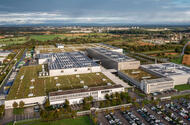
Facility will recover enough raw materials to create 5000 EV batteries a year
Mercedes-Benz has opened a new plant capable of reclaiming 96% of the raw materials used in its electric car batteries.
The new facility in Küppenheim, southern Germany, will recover materials such as lithium, cobalt and nickel from existing electric car batteries so that they can be used in the production of brand-new cells.
Mercedes' process mechanically separates the aluminium, copper, iron and plastics present in each battery, before using an aqeuous solution (hydrometallurgy) to recover the rare-earth metals from the remaining 'black mass' of chemicals from the electrodes.
The mass is dissolved into a liquid solution and filtered to separate the graphite, iron and aluminium, before it is neutralised using ammonia and hydrogen peroxide. Then it is treated with sulphuric acid, ammonia and an organic solvent. This yields sulphates of copper, cobalt, manganese, nickel and lithium. The cobalt and nickel are crystallised before being recovered.
When fully operational, the plant will yield 2500 tonnes of recycled material, enough for 50,000 battery modules (or 5000 EV batteries), annually.Â
It also uses less energy than traditional pyrometallurgical processes (such as smelting), helping the Küppenheim plant to operate on a carbon-neutral basis.
To that end, will be run solely using renewable electricity, with the factory’s roof packing a solar panel array that’s capable of supplying up to 350kW.
“We are now sustainably closing the raw materials loop in Kuppenheim,†said Jörg Burzer, Mercedes board member for production, quality and supply chain management. “The innovative technology enables us to recover valuable raw materials from the battery with the highest possible degree of purity. This turns today's batteries into tomorrow's sustainable mine for raw materials.â€
Speaking at the opening ceremony for the plant, German chancellor Olaf Scholz added: "The whole world is talking about de-risking and material security – what better approach than to reuse materials?"
The Kuppenheim plant is backed by battery recycling company Primobius as well as Germany’s Federal Ministry for Economic Affairs and Climate Action.