Affordable hybrid tech has democratised rugged SUVs in China, sparking a clash over automotive originality
Back in June, JLR voiced its concern to investors that Chinese car makers were copying its most successful design.
"I probably would not be exaggerating if I said there are 100 [Land Rover]Â Defender copycats," said chief commercial officer Lennard Hoornik.
In August, the British firm acted on its concerns by starting legal proceedings against the first of those Chinese copycats to bring its Defender-alike to Europe.
The BYD Ti7 is by far the most successful of the new crop of large Chinese SUVs adopting the fashionable off-roader styling, and JLR wanted European sales stopped.
“The Ti7 is a shameless copy of the Defender,†JLR stated in its claim that the new BYD infringed on its design.
On 20 November, a Dutch court sided with JLR and ordered BYD not to sell the car in the EU in a preliminary judgement. UK sales are unaffected.
BYD in a statement said it “strongly disagreed†with the judgment and promised to appeal, claiming: “The BYD Ti7 is the result of BYD's own independent design work and infringes none of JLR's rights."
The case exposes a weakness in the otherwise unstoppable rise of Chinese car makers globally. JLR pounced on it.
“It's a counter-attack. It says 'we're under siege. The Chinese are taking market share everywhere. Let's hit them where they might be vulnerable,’â€Â Michael Dunne, head of China-focused automotive consultancy Dunne Insights, told Autocar.
While the Chinese have become globally innovative on the tech side, design remains a weak spot.
“Everyone suspects that the Chinese still do a little bit of what they call R&D: receive and duplicate,†Dunne said. “So JLR is going to probe and see if there's a weakness there.â€
JLR outlined all the ways the Ti7 resembled the Defender: the convex shoulders, the rounded corners, the bodywork-coloured ‘signature panel’ forming the C-pillar, the cut-out of the wheel arches with rounded corners, the continuous window line and the overall proportions. The judge agreed.
So why does a confident, innovative and successful car maker like BYD feel the need to copy another company's design?
“In the West, if you wish to an insult a designer, you would say 'gosh, that looks a bit like something else',†said Sam Livingstone, director at Car Design Research. “Say the same thing to a designer in China and that may very well be a compliment.â€
According to Livingstone, the car industry is so cut-throat in China that it’s too risky to go bold in a design.
“If you want to create something with broad appeal, you might get there not by sticking your head above the parapet but by creating something which customers will have less reason to not buy,†he said.
The Ti7 is more noticeable because it's now being launched in the UK after hitting the top 10 in China, but there are plenty of others.
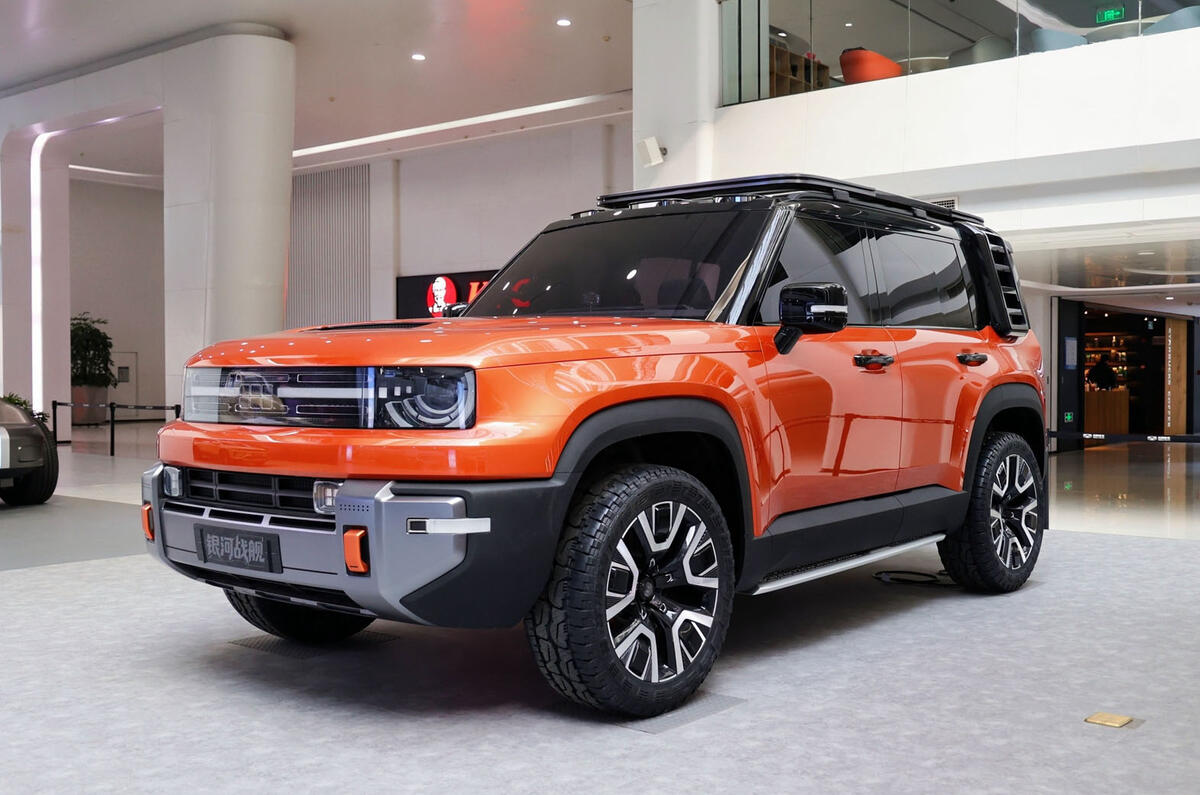
One of the most egregious is BAIC's new Xingtan 5X (pictured below), which like the Ti7 comes as a plug-in hybrid and an EV in China.

The 4865mm-long car more overtly copies the Defender with its rounded front lights, black side vents and squared rear lights.
Media in China have dubbed it the “poor-man’s Defenderâ€, given that it starts at the equivalent of £15,000 there.
A car like the Defender was once firmly premium, but the Chinese have democratised the segment wit plug-in hybrid drivetrains. Now everyone has piled in.
“The market is super-competitive and all the segments are very crowded already. This segment is one of the few with potential,†Michael Yang, head of Geely in the UK, told Autocar.
Chinese brands originally didn’t have the right combustion engines to power such big, heavy cars and pure-electric power made them even heavier, due to the quantity of batteries needed.
“Super-hybrid technology [ie long-range PHEVs] start to solve that problem. They perform very well and it brings a fresh experience for the users. So it's becoming more and more popular,†Yang said.
So why is just the Defender being singled out for copying? It’s not, argues Livingstone: “Most car designs in China are equally close to other leading competitors. It's just that in this instance, this leading competitor is very distinct."Â
There are plenty of designs in China that look like the Porsche Macan, Volvo XC90, Range Rover or Porsche Taycan.
“The place is awash with them. But those designs are not so distinct relative to the generic core of those vehicle types, whereas the Defender is,†Livingstone said.
The JLR/BYD court case is likely to focus the minds of Chinese car makers as they look to export more of these SUVs to Europe.Â
For example, Geely is bringing its take on the large, chunky, PHEV off-roader, the Galaxy Cruiser (pictured below), to the UK next year.
Yang said the company would “assess†whether the design should be changed in light of the JLR/BYD case but said he thought it wouldn’t be a problem.
The issue for European premium car makers is that they have the design and brand strength but don’t yet have the technology or cost control to properly compete with the Chinese.
The recently agreed import quotas on Chinese hybrids into the EU should help, but the Chinese have indicated that they are likely to pivot their hybrid imports to higher-end models while localising production of their volume models.
In bringing the case against BYD, JLR could also be helping its Chinese joint-venture partner Chery as it prepares to import its new Freelander SUV to Europe.
Thanks to design input from JLR, this is one squared-off SUV from China that isn't a Defender clone.
“This JLR battle is just as much as protecting the licensing fees coming from Chery as it is in protecting its IP [intellectual property] and design from BYD,†argued autos analyst Matthias Schmidt.
Chery is also bringing over iCaur, another new brand following the likes of the Defender and Ford Bronco, to sell a range of blocky PHEV SUVs.
The Chinese ethos of packaging lifted designs around cheaper tech can't last, however, as car makers look to establish themselves as long-lasting brands.
“It’s an unsustainable approach,†said Livingstone. “As soon as you take cost out of the equation, design actually has to fulfil the purpose of being a reason that somebody chooses something over another thing. If you seek to closely emulate the competition, that fundamentally cannot work for very long.â€

