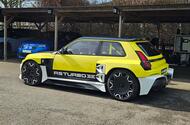
British firm takes its radical new EV propulsion tech to the showroom with Renault's mad hyper hatch
Patience is a virtue, the saying goes, and in Protean Electric's case, persistence and hard work have paid off.
Protean's in-wheel motor (IWM) technology is being adopted by Renault to power its 5 Turbo 3E, which is due to go on sale in early 2027 as the first European car to be fitted with IWMs.
Protean has been working on IWM technology for around 17 years and has been exhaustively pursuing solutions to its potential pitfalls for production cars. These include unsprung mass, water and dirt ingress, the integration of a friction brake and thermal management.
During that time, the firm has found solutions to technical challenges and exposed others as long-standing misconceptions. It has found ways to integrate friction brake systems, keep the tightly packaged electronics cool (each IWM has its own integrated inverter) and simplify communications between individual components and wheels. The IWMs have been developed to last a vehicle lifetime of more than 186,000 miles, withstanding shock and vibration, potholes and kerb strikes.
The 5 Turbo 3E is rear-wheel drive and will produce 550bhp, with 3540lb ft of torque. Performance will be staggering: the 4m-long car will hit 62mph in less than 3.5sec.
Protean had only two years to develop motors specifically for the project. Its most powerful 'off- the-shelf' IWM is listed as the PD18, which produces 138bhp, so two of those would total 276bhp. The extra power for the 5 Turbo 3E is the result of further development and set-up from the Alpine engineering team, says Renault, no doubt in collaboration with Protean engineers.
One of Protean's biggest challenges has been addressing the potential impact of unsprung mass due to the extra weight of an IWM compared with a conventional wheel hub. The firm has commissioned several independent studies by third parties and Lotus Engineering also worked on the Protean-Mahle VW Golf.
The key conclusion, says Protean, was that the effect on ride and handling due to unsprung mass could be offset by adopting stiffer suspension components and stiffer settings.
As for the brakes, the disc brake rotor is bolted to the motor assembly and the caliper to the suspension acting on the inside diameter of the disc. Protean has been working with brake manufacturer Alcon since 2011 and testing has established that the brake performance matches that of standard, non-EVs, with testing on vehicles of up to 3500kg.
Thermal management involves both hardware and software with a patented cooling system design.
Overall, Protean holds more than 320 patents and its portfolio of IWM solutions covers light commercial and autonomous vehicles as well as cars. It has also developed the Protean360+, a wheel corner module that, as the name suggests, can rotate through 360deg to move a future urban mobility vehicle in any direction.