Sleek new mid-sized Rangie is completely unrelated to Type 01 - but there could be a Jag link
Some people have suggested that the new Range Rover GT is an inflated Jaguar Type 01 – which is an understandable thought.
It's the sort of thing a car company would normally do, after all: create a new platform and then have it underpin lots of new models; first that, then this.
It's even less surprising considering that the first bit of the GT to have been fully revealed is its interior, which looks quite like the one in the upcoming Type 01: bright but button-light, just as the rest of the world is pivoting back towards the tactility and functionality of physical controls.
I'm told the GT will ultimately have a rounder steering wheel than the one in pictures, though.
Yet the GT isn't a lifted Type 01 at all, sitting as it does on an all-new platform, which becomes evident when you climb into both cars.
The Type 01 has separate battery packs in its all-aluminium Jaguar Electric Architecture (JEA), which occupants sit on but with their feet between, allowing them to be located very low in the car, so the roofline can be sleek.
The GT isn't like that. Occupants sit on the batteries, which are arranged more conventionally in a pack under the floor of this brand-new, electric-first but hybrid-accepting Electric Modular Architecture (EMA).
The cabin floor is flat and much higher than the Jaguar's and is extremely spacious too - not a defining trait of the Type 01.
If the GT does owe something to a Jaguar, it's not the Type 01 but the I-Pace. Chief engineer Matt Eyes told me that lessons learnt there have been applied here, particularly in terms of battery crash safety.
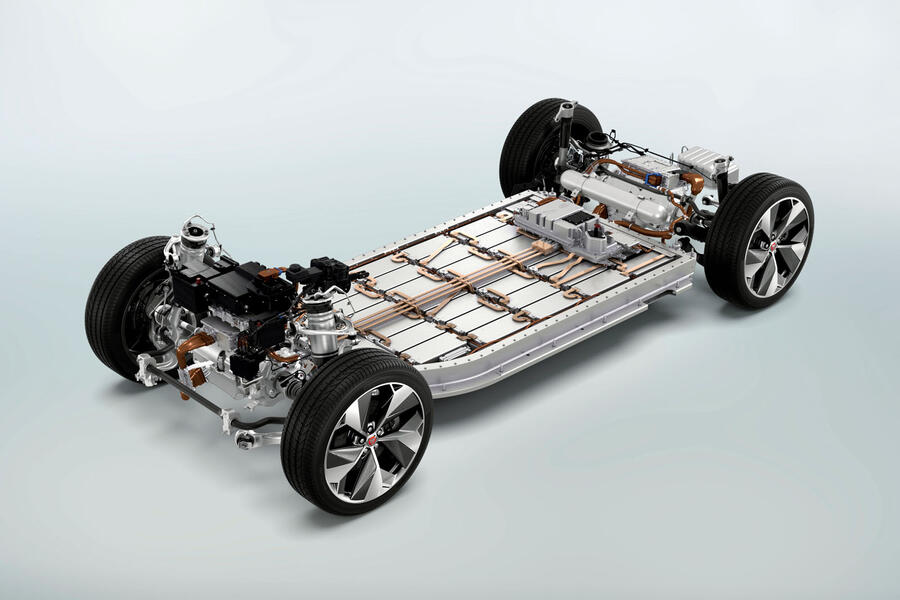
The I-Pace's pack (pictured above)Â was given chamfered corners for this purpose, but that reduced capacity, given its dimensions, to less than 90kWh. Now the engineers are better at designing it, allowing an EMA pack to hold up to 120kWh of energy.
Given this architecture isn't entirely unlike a Mk2 I-Pace's would be, then, could it one day underpin a Jaguar? They won't say, of course, but it's easy enough to imagine the brand wanting a new crossover/SUV at some point down the line.
This platform's cab-rearward design differs from that of the first I-Pace but is in keeping with Jaguar's latest language.
The hybrid opportunity presented by the EMA is for a front-mounted engine - albeit not, Eyes says, anything as big as a six- or eight-cylinder.
This Range Rover GT, though, is a car that JLR has wanted to make for some time. If you were being particularly arcane, you could say it finds its roots in the 1950s Road Rover project, well before the Range Rover was even imagined.
Several prototypes of this rugged station wagon were made, one of which survives at the British Motor Museum in Gaydon.
Eyes says JLR has more recently experimented with several lower, sleeker Range Rover models, getting quite a long way down the road with development of one lately before deciding it didn't quite suit its underpinnings.
Having not found an architecture right for the job, then, the EMA was created in part specifically to enable this car.
That's quite a JLR thing to do: create a new architecture to underpin fewer cars than rival manufacturers would make.
And over the coming months it will become clear just how much bespoke work the company has done with it, as it has with the JEA.
I do wonder what effect this approach has on its cars' performance in the hands of customers.
Some manufacturers would force new cars to fit known platforms or outsource high proportions of components to suppliers. JLR's insistence on doing its own thing when off-the-shelf parts aren't appropriate, as a middle-sized car company, creates cars that nail their briefs and which new buyers love but which does leave it exposed if any of those components have issues.
Anyway, which other models will the EMA underpin? The Range Rover GT will wear a Land Rover badge, not as branding per se but as what JLR now calls a 'trust mark' within its 'house of brands' (bleurgh), yet I don't think it's likely to suit a full-sized Defender model.
I do find it easy enough to imagine it under a Discovery - albeit since the arrival of the new Defender and with more Range Rovers around it, that brand is seemingly still searching for its happy place.
And it could yet be a Jaguar too, of course.
The Range Rover GT isn't a lifted Jaguar in any way, but who's to say it won't yet become one?