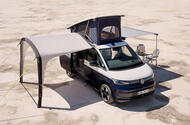
Seventh-generation California also gets car underpinnings, interior improvements and new technology
Volkswagen has revealed its seventh-generation California camper van.
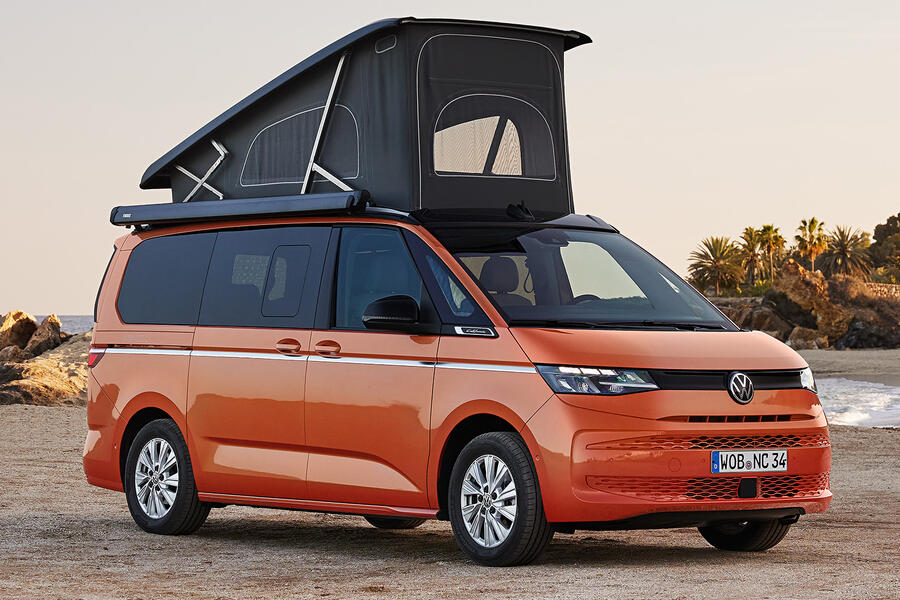
Set to go on sale in June before deliveries begin in the second half of the year, the new California strongly resembles the concept shown by the German firm in 2023.
The California is now derived from the Volkswagen Multivan MPV, rather than the Transporter van, so it sits on the Volkswagen Group's MQB car architecture.
Measuring 5173mm long and 1941mm wide, the new California is 269mm longer and 39mm wider than its predecessor, while its 1990mm height is identical.
Along with a slight increase in size, the new California introduces a host of new design and practicality changes.
It’s the first California to come with two sliding doors as standard, with one on each side of the van.
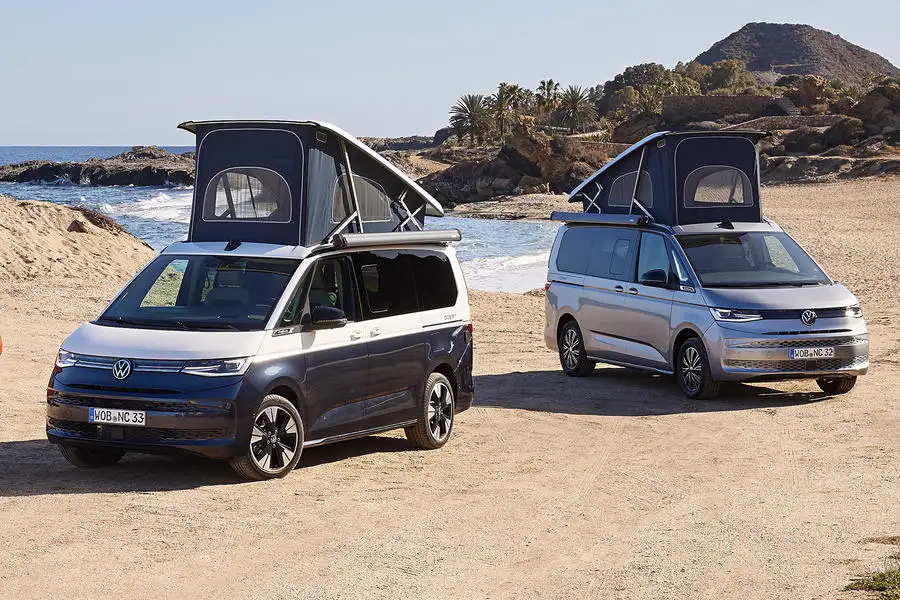
This means that both sides of the van can now be used for entering and exiting the rear and that the kitchen – with larger worktops, a hob, a coolbox and a sink – is now accessible from outside for the first time.
Optional awnings can be fitted to either side of the van.Â
The rear seats are now separate and individual, whereas the previous California featured a bench seat.
But the key interior feature is the addition of a new control unit with a 5.0in display, housed on the passenger-side C-pillar. This can be used to raise the pop-up roof, adjust the interior lighting, operate the fridge and heater and check the waste and water levels.
These features are also controllable through the driver’s smartphone and the touchscreen infotainment system.
The California will be available with a choice of petrol or diesel engines but is also the first Volkswagen camper to offer a plug-in hybrid powertrain.
The powertrain range opens with Volkswagen's familiar four-cylinder turbo diesel engine with 147bhp. The petrol engine is a turbo four offering 201bhp. Both drive the front axle.
The PHEV variants come with Volkswagen’s 4Motion four-wheel-drive system and combine the firm's 1.5-litre turbo petrol four with an electric motor and a battery.Â
Volkswagen hasn't confirmed the size of said battery or the van's electric-only range, but last year's concept used a 13kWh unit that allowed for around 25 miles of range, so we expect the production variant to offer something similar.
The PHEV California can tow up to two tonnes.
Five specification levels are available on the California: Beach, Beach Tour, Beach Camper, Coast and Ocean.
Volkswagen describes the entry-level Beach as “essentially a Multivan with a manual pop-up roof". It has six seats, meaning there’s no room for a bed below, so there are only two sleeping berths.
The Beach Tour has five seats that can be folded flat to form a bed, with a mattress included. It also adds rotatable front seats, a folding table, two folding chairs housed in a bootlid compartment, sliding windows and that new digital control panel.
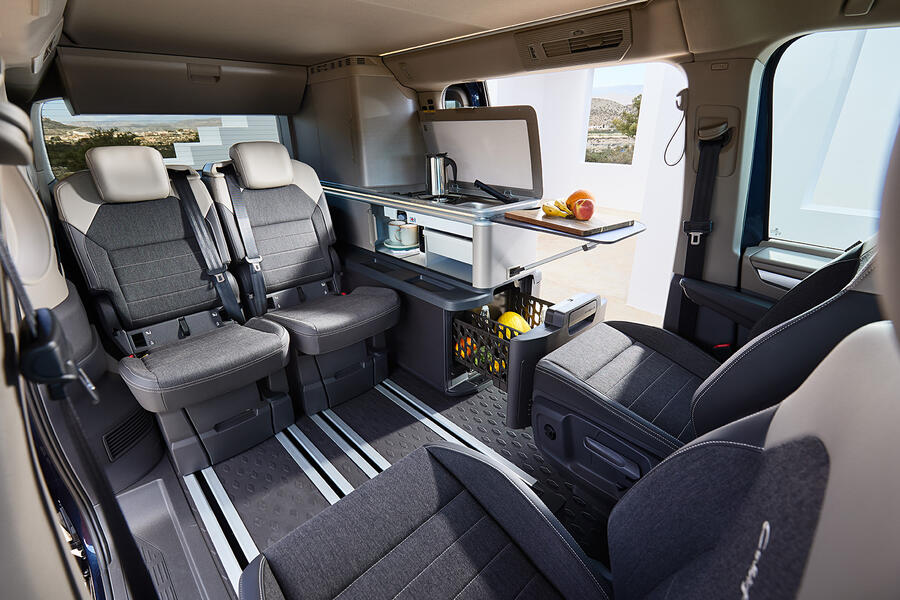
Volkswagen said the Beach Tour represents its “classic camper vanâ€, adding kitchen elements such as a single-ring gas cooker, a cutlery drawer and more storage space. It also gains a 230V power supply.
The Coast drops to four seats but gets a larger, well-packaged kitchen, adding a fridge, cabinets, a sink and a second camper battery.
The Ocean gets all of that plus fabric seats made from recycled materials (with heating function for the driver and passenger), an auxiliary air heater, climate control and a roof-positioned storage box.
Volkswagen hasn't detailed pricing for the California yet, but it's likely the new van will cost more than its predecessor. PHEV variants in particular are expected to command much higher prices.
The sixth-generation California currently starts at £61,462, rising as high as £81,208 for the range-topping Ocean when equipped with a 2.0-litre diesel and four-wheel drive.
The California’s key rivals, the Mercedes-Benz V-Class Marco Polo and Ford Transit Nugget, start at £83,490 and £76,027 respectively.
There’s still no electric California, but we don’t have to wait much longer: Volkswagen Commercial Vehicles CEO Carsten Intra confirmed in March last year that an ID Buzz-based camper will arrive in 2025.Â