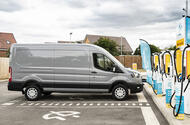
Key to the claim by analytics firm Geotab is the low average daily mileage driven by UK fleets
The UK is the most suited market in Europe to the mass-adoption of EVs, especially fleets, according to new data that analysed 1.3 million vehicles across seven countries.
In its 'Taking charge: on the road to an EV future' report, analytics firm Geotab claims 66% of combustion-powered UK-based fleet vehicles could be swapped for an electric alternative without impacting daily usability and saving businesses thousands of pounds in costs.
The key to this claim is the mileage driven by UK business motorists. Over 12 months, tracked vehicles averaged 52 miles a day – “well within the limits of current EV technologyâ€, Aaron Jones, Geotab’s AVP sales and business development, told Autocar.
“Of the [vehicles we tracked], 49% never drove more than 250 miles in a day during the period of the study,†he added. “That data indicates that that's not going to be a problem to mass adoption. And then, if you do suddenly need to drive more than 250 miles, that's manageable.â€
Commercial EVs currently on the market offer a breadth of ranges. For example, at the larger end, a loaded Ford E-Transit has a range of 101 miles and a Mercedes-Benz eSprinter 83 miles, whereas the smaller Citroën e-Berlingo van can cover up to 211 miles.
For firms that require larger vans, these ranges would be more problematic in countries such as France, Jones said, where vehicles travel an average of 80 miles per day. This means drivers would have to plan daytime charging stops, therefore impacting current business operations and requiring more work to transition.Â
France was found to be the least suited market for EVs, with just 20% of vehicles identified as being able to be swapped for an EV. Behind the UK was Spain (43%), Germany (35%) and Italy (28%). The UK was also reported to be better equipped than other Western powerhouses such as Canada (50%) and the US (38%).
“The idea that the UK is not ready for mass EV adoption is a fallacy,†said David Savage, Geotab’s vice president for the UK and Ireland, adding that this is contrary to increasing industry and media pessimism around EV adoption.Â
“It’s time for British businesses to double down on fleet electrification - not just for the good of the environment and our collective climate goals but for their bottom line,†Savage said.
That doubling down could save firms as much as £13,279 over seven years in ownership costs, the report claims, and if those 66% of identified ICE vehicles were swapped, it would reduce CO2 emissions by 19 million metric tonnes over the same period.
What makes the UK’s top spot more interesting is the lack of incentives it currently offers compared with other European countries. The report noted that France, Germany, Italy and Spain all offer EV purchase incentives.
“The UK could support businesses with greater incentives,†said Jones. “The Nordic countries are very much leading in that regard [with big VAT cuts]; companies are heavily incentivised to make that transition.
“Incentivising businesses to put money into a charging infrastructure is equally as important.â€
However, Jones admitted that transition to electric vehicles right now will not be the right move for all firms - but data could be the key to helping them understand this
“Insight that can come from data will be invaluable,†said Jones. “There are large fleets in the UK that adopted EVs early. They said ‘we’re just going to get EVs’, then they’ve had loads of problems. That's where the pessimism comes from.
“So we're always advising fleet managers and procurement officers, our customers and our non-customers to take a data-driven approach to gaining that insight.â€