Falken’s parent company is using AI to reduce aerodynamic drag on tyre surfaces for its 2027 tyre
Artificial Intelligence is being used for some alarming things (creating fake videos, for instance), but some positive purposes for it are emerging as well.
For instance, Falken’s parent company, Sumito Rubber Industries, is using AI as part of a tool called Tyre Aerodynamic Simulation, with which it aims to reduce the aerodynamic drag and improve electric car range.
It attempts to mitigate against even the smallest surface details on a tyre, and the results will be used in the development of a next-generation, low-energy-consumption tyre due to be launched in 2027.
Tread design, the formulation of tyre compounds and sidewall design already play a large role in reducing the rolling resistance of tyres, both for electric cars and ICE vehicles.
Hysteresis caused by the tyre consuming energy when it deforms while rolling along the road and then some of that energy being lost as heat when the tyre returns to its normal shape has also long been a target of engineers in reducing rolling resistance.Â
And with decades of experience already gained in those traditional areas, the latest testing technologies are being brought to bear on reducing air resistance.
It has long been understood that the aerodynamics of a rolling wheel and tyre in relation to the bodywork around it can make a hefty contribution to a car’s energy losses.
That’s why car makers pay such close attention to design details and introduce features like air curtains to channel airflow around the front of the car over exposed wheels to cut drag.
EV development
Air resistance is now becoming more of a focus in EVÂ development, because where ICE cars lose more than 50% of the energy in the fuel they burn as heat, an EV drivetrain is massively more efficient, and therefore air resistance forms a larger percentage of their total energy loss.
Sumito attributes 20-25% of that loss to aerodynamic drag on the tyres of an ICE car; in an EV, add in rolling resistance and that figure rises to 34-37%.
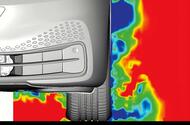
Its Tyre Aerodynamic Simulation tool crunches real-world data derived from vehicles to visualise air resistance around the tyre and make calculations, which AI then analyses.
Visual representations of the airflow show that even over the finest textures on the sidewall, large swirls are created as the airflow breaks up, increasing drag. At the same time, the AI analysis takes into consideration the effect of the deflection of the tyre due to the car’s weight.
It also provides a simulation that helps engineers design the fine lettering and other markings on the sidewall to reduce drag to a minimum.
Does it work? Back-to-back wind tunnel testing was used to validate the results of the simulation, showing how decreased airflow behind the tyre and a smoother, more even sidewall design reduce drag compared with the standard tyre.
Bringing AI to bear on the simulation also indicates that the role played by the sidewall design in the overall picture becomes greater as air resistance around the tyre increases.