Brands love to shout about British production, but I'm not sure a Union Jack helps to shift metal
How much do we care where our cars come from? Not specifically you and me, I mean; you're reading a British car website, and there's a strong chance you're invested, at least emotionally, if not professionally, in the car business.
But what of 'the man on the Clapham omnibus', the legal profession's hypothetical ordinary, reasonable person on the street, someone uninvested, just going about their business? Do they care?
Certainly they’ll know about it much more readily than they know where, say, their plastic buckets, clothing, processed food or the hypothetical bus in which they're travelling comes from, because the busyness, or otherwise, of their local factories will be big news.
'UK car making plunges to lowest for over 70 years', ran a BBC headline earlier this summer (partly, but far from exclusively, because US trade tariffs made JLR press pause on sending cars to America). But it's not just a British worry.
â€There are concerns in Germany, Italy, France and Japan," Prof Peter Wells of Cardiff University's Centre for Automotive Industry Research told the BBC at the time. "It's not purely a UK phenomenon." Traditional car-building countries are struggling to make as many cars as they used to. And you'll know as well as I do what some of the causes of this phenomenon are.
Chinese cars were, not very long ago, something of a novelty and, if we're honest, not a terribly competitive one. With what now looks like naivety, the European car industry seemed to assume things would stay that way.
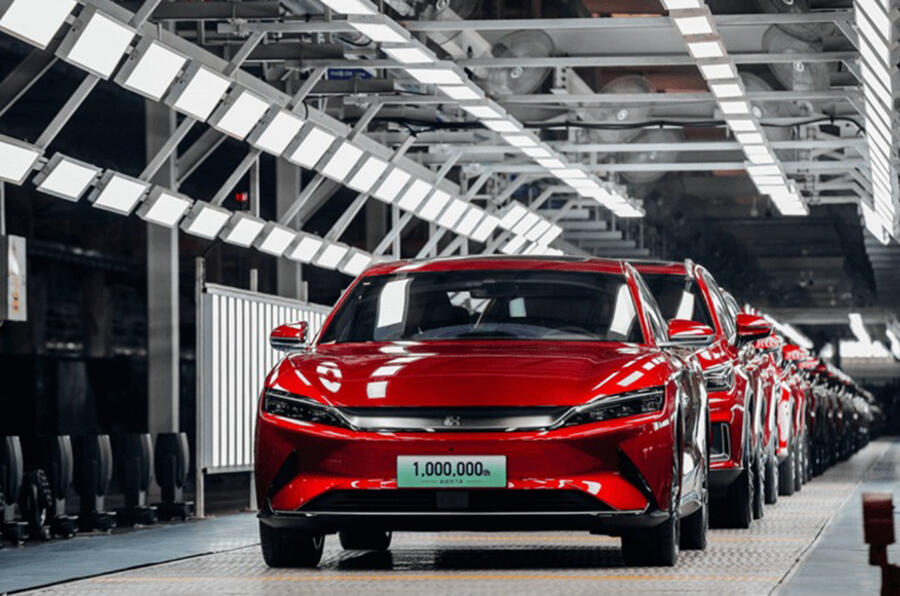
Overseas car makers were very welcome to open new factories in China, they were told, where there was a burgeoning domestic middle class to sell to but they could only do so in joint ventures with local companies.
Those local manufacturers have since learned very ably how to build cars without foreign help, and they have the advantage that, unlike most European car makers, they also happen to be leading tech companies. That means they can now do the software and the hardware. As a result, the 31 million cars China makes a year is the biggest number by any nation in the world by three to one over the next biggest, the US. It turns out, too, that Chinese buyers would gladly have a local, rather than foreign, badge on their bonnet.
Do we by which I mean British omnibus passengers care the same way about who makes our cars? The influx of Chinese EVs here, following an Uber-style rollout of undercutting and rapid expansion to achieve market dominance, suggests not. A shame. We're encouraged to buy and support local with things like our food. Why not our vehicles?
I wonder if British omnibussers differ from those in, say, the US, Japan, Germany or South Korea, because our big car industry players have been foreign-owned for decades. British buyers can choose a locally built car with a Nissan badge, or a Chinese-badged car that might still be built in mainland Europe (BYD's Hungary factory comes online next month).
If they think their responsibility as a consumer ends at buying the best-value, most competitive product for their family's needs, how much, personally, will they care either way? How much should they?
In other 'legacy' (for want of a better word) car-making countries, the streets are more dominated by domestic-built, domestic-owned products, in the way that ours (unfortunately in my eyes) are not. But even local support won't insulate them from very good Chinese cars and what European car makers believe is legislation supporting them.
Mercedes-Benz's CEO, Ola Källenius, last month said zero-emissions targets could collapse the European car business. "We need a reality check otherwise we are heading at full speed against a wall," he told German newspaper Handelsblatt.
He's not the only big cheese worried, but there's also acknowledgement from some old-school makers that their products need to be more appealing. Bill Ford raised similar concerns to Källenius with Autocar recently, but he also said Ford's European car line-up needed to be "more robust" in other words, a lot better.
Renault is perhaps the nearest thing a midmarket European car maker has to a benchmark; while it posted reduced half-year profits in July, it did at least, owing to its attractive new EVs and great value Dacias, still record good profits.
It's a model others might do well to follow, because while I think having a crumbling local industry is bad news, I'm not confident about who might prevent it from happening. Will legislators really soften rules that shrink the market? Will consumers look beyond the quality of the car and the price in the windscreen? I suspect not. If the European car industry wants saving, I think it will have to do it itself.