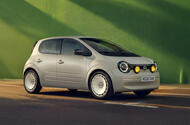
New electric city car will tap Pike models – Be-1, Figaro, Pao and S-Cargo – using Renault Twingo underpinnings
Nissan has chosen the name Wave for its version of the Renault Twingo electric city car and will rework the design with influence from its Pike retro cars, Autocar has learned.Â
The Wave is due next year and will be built by Renault alongside the Twingo.Â
It is expected to hit the same sub-£20,000 price point as the Twingo, thanks to the use of cheaper, lithium-iron-phosphate chemistry for its 27.5kWh battery.Â
Nissan Europe head of design Giovanny Arroba has told Autocar the car's design will be inspired by Nissan's late-1980s and early-1990s retro small cars known as Pike cars, after the firm's Pike Factory special project group.Â
The Wave name was confirmed by a separate source at Nissan.Â
The Pike cars were based on the first-generation Nissan Micra and sparked instant affection in Japan and beyond for their exaggerated references to 1950s automotive design, with details such as exposed hinges, side strakes and prominent door handles.Â
The first – the Be-1 supermini – generated so many orders when it was shown at the 1985 Tokyo motor show that Nissan had to run a lottery to choose who got to buy the 10,000 destined for production.Â
The Twingo itself has been given a retro flavour in reference to the original 1990s car. That has given Nissan a good basis on which to stamp the Wave with its own personality without having to make too many expensive changes, similar to the Renault 5-based Micra.Â
How deep Nissan will go in replicating the Pike cars' look remains to be seen but the company will have noted how successfully its Alliance partner Renault has leveraged retro appeal with the 5 and 4 small electric cars.Â
Using the shortened version of the Ampr Small platform, the Wave will be the same size as the 3.79m-long Twingo and is also likely to match that car's 163-mile range.Â
Nissan will benefit from many of Renault's cost-cutting achievements with the Twingo, including a claimed development time of just 21 months, speedier production from a reduced part count and a low-cost battery sourced from CATL.Â
The Japanese firm has not competed in the European city car segment since it axed the Indian-built Pixo in 2013 but small cars are now attractive again after the European Union agreed to give makers of small EVs 'super-credits' worth 1.3 EV sales to boost regional manufacturing.