We fit a a hybrid solar system to our garage to see how much money we can save on charging our Kia e-Niro
Installing solar panels may have seemed like an expensive luxury to most of us some time ago. But now it seems like a way out of the fuel crisis hitting the UK.
I had made the switch to EVs in 2021, and although it wasn’t part of a master plan, suddenly the idea of turning the house into a mini power station became strangely compelling.
If a solar system is producing more energy than can be used there and then, EV batteries are an ideal place to store it.
Solar systems come in various types. The most popular option is to install a hybrid system, integrating inverter, solar panels and battery storage together. The inverter also manages the flow of power between house, batteries and, when excess power is produced, back into the grid.
Batteries can also be charged from the grid on a low tariff, then the power used during peak periods, but they’re not that big, which is why EVs with their huge storage capacity are an ideal accessory.
My starting point was to check the household energy bills, which told me that over the past 12 months, including charging two EVs at home, we had used around 6500kWh (units) of electricity.
For solar systems to be effective, they ideally need to be facing south or thereabouts, and my garage faces south-south-west and is free of shade for most of the day. So far so good, and I thought it might be possible to generate around 6000kWh a year.
Interest-free loans for solar systems are available from the government in Scotland, where I live, via the Energy Savings Trust, but even using a commercial low-interest loan would still stack up. To qualify, I had to use an MCS-certified installer (Microgeneration Certification Scheme), who should adhere to a set of standards for installation and equipment.
I opted for hybrid (solar plus batteries) and my chosen installer, Locogen Energy Services, came back with a quote that included several pages of information such as expected daily energy flows for the area I live in, system performance predictions and environmental benefits.

Locogen’s specification was for 16 420W solar panels giving an ‘installed capacity’ of 6.72kW capable of producing an estimated 6008kWh (units) per year.
They would be hooked up to a 5kW-rated Solis hybrid inverter to convert DC electricity from the panels to AC, a 48V, 4.8kWh Pylontech lithium-iron-phosphate battery (Locogen recommended two of these and I would upgrade later) and a wi-fi dongle to connect the system to the phone app via the Solis cloud.
That lot would cost £11,000, with a forecast payback period of 5.9 years and a predicted return on investment of 682%. On top of that, I had to pay a fee of £300 for G99 approval from the distribution network operator. Approval is required if connecting anything larger than a 3.86kW generating system to the grid.
Once it’s fitted, you can either forget about it or continually obsess over the app and, naturally, I chose the second option. The system feeds the home first, then the batteries and then anything left over is fed back to the grid.
An Ofgem thing called the Smart Export Guarantee means home owners get paid anything from around 5p to 15p per unit, so long as you sign up to it. At best, that’s less than half a typical electricity tariff today so it’s important to use what you make, not give it away on the cheap.
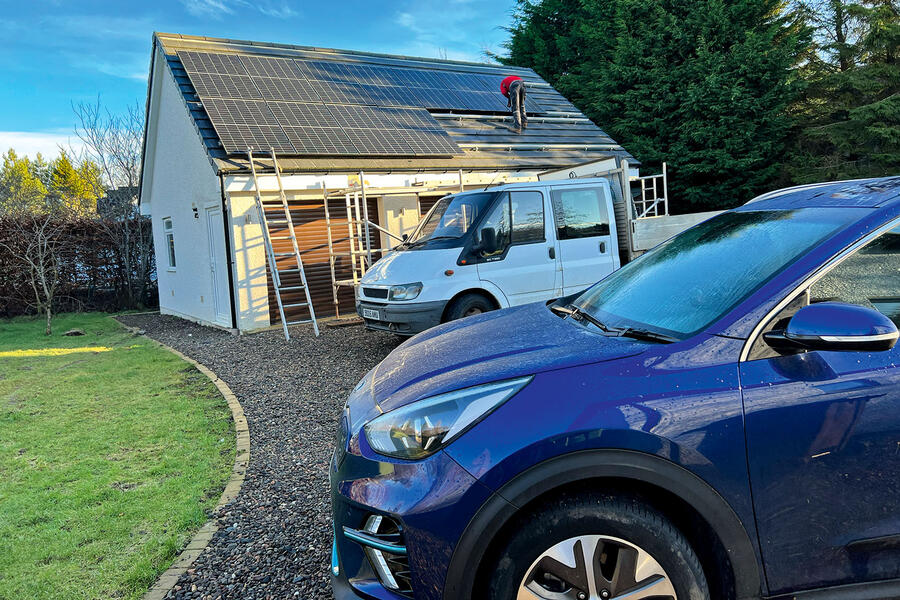
This is where EVs come into their own, with their large batteries ready to take on any excess. When the solar system is at full power during the day, the house may be drawing only a few hundred watts, and once the solar batteries are fully charged, the rest will be exported.
Rather than see several kilowatts of energy flowing into the grid, I leave the family Kia e-Niro plugged into the 13-amp trickle charger. If the sun is shining and a quick look at the Solis app confirms there’s energy to spare, I turn charging on and off using Kia’s UVO app.
Does it work? To break even against monthly loan repayments, we need to generate and use an average of 226kWh per month.
Typically we use around 330 of a total 380 generated. The rest (13%) was exported and I need to reduce that, but we’re still ahead by more than £50.
The day before this was written, a cloudless day yielded 34kWh of electricity and a good chunk of that ended up in the EV, so roll on summer.Â