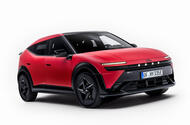
Small EV offers up to 309 miles of range and features 441 litres of boot space
Hyundai has lifted the covers off the Ioniq 3, its new electric hatchback that will arrive in the UK this year priced from around £25,000.Â
Positioned as a rival to small electric cars such as the Renault 5 and larger alternatives including the Volkswagen ID 3, it is described by Hyundai as an ‘aerohatch’ – a sleek new form conceived with the goal of maximising aerodynamic efficiency.Â
This approach has resulted in a raked roofline, similar to that employed by the old Hyundai Veloster, ending with a prominent duck-tail rear spoiler. The rear lip is moulded into the leading edge of the boot, but range-topping N Line cars get an extension for a sportier look. The front end, meanwhile, was sculpted to have the smallest frontal area possible.Â
Its efforts have yielded a drag coefficient of 0.26, which is better than the smaller but chunkier Renault 5 (0.29). As a result, the Ioniq 3 is said to be capable of driving 208 miles between charges when fitted with the standard 42.2kWh battery or 309 miles with the larger, 61kWh pack.Â
Lead exterior designer Manuel Schöttle said Hyundai began with the most efficient shape in aerodynamic terms for the Ioniq 3, but added it was “important to make sure it didn’t look like a soap barâ€.Â
He said it was Hyundai’s first electric car designed in Europe, and noted that it uses Hyundai’s new Art of Steel design language.Â
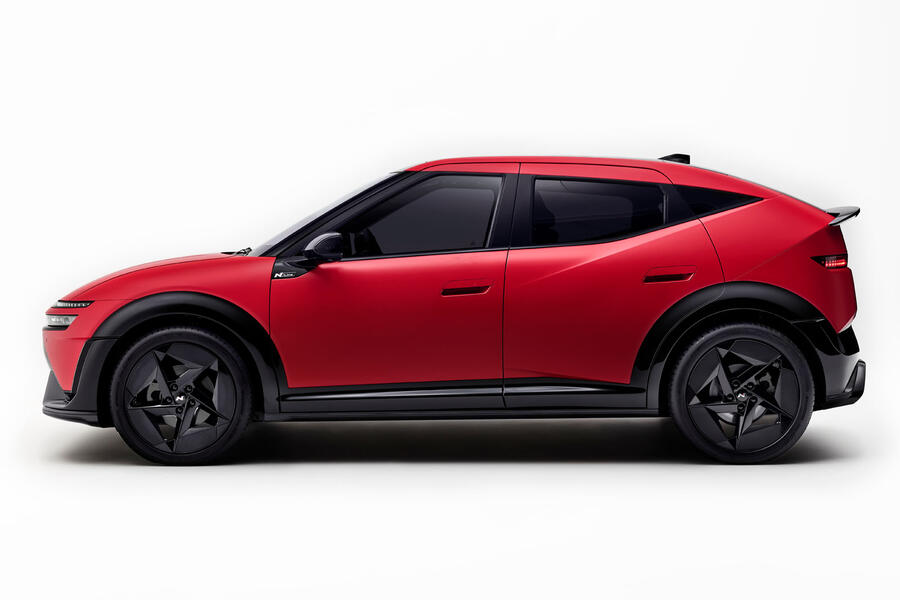
Yet the radical silhouette also brought several compromises inside the Ioniq 3. For example, the roofline’s rake ate into the boot space, and the small front end combined with the model’s front-wheel-drive configuration meant there was no space for a frunk. The workaround was to create a large cargo space below the floor, similar to the ‘Gigabox’ in the Ford Puma Gen-E increasing load space from 322 to 441 litres. Indeed, that raked design also ate into rear cabin space, so Hyundai carved into the car’s headlining to free up a few millimetres more head room.
The Ioniq 3’s cabin was designed to free the driver of as much distraction as possible. Lead interior designer Victor Andrean said the “hands on the wheel, eyes on the road†philosophy brought a rethink of the dashboard’s layout.Â
That resulted in a thin new digital instrument panel that is set notably higher than in existing Hyundais; it is paired with a smaller steering wheel, resulting in a similar set-up to Peugeot’s i-Cockpit.Â
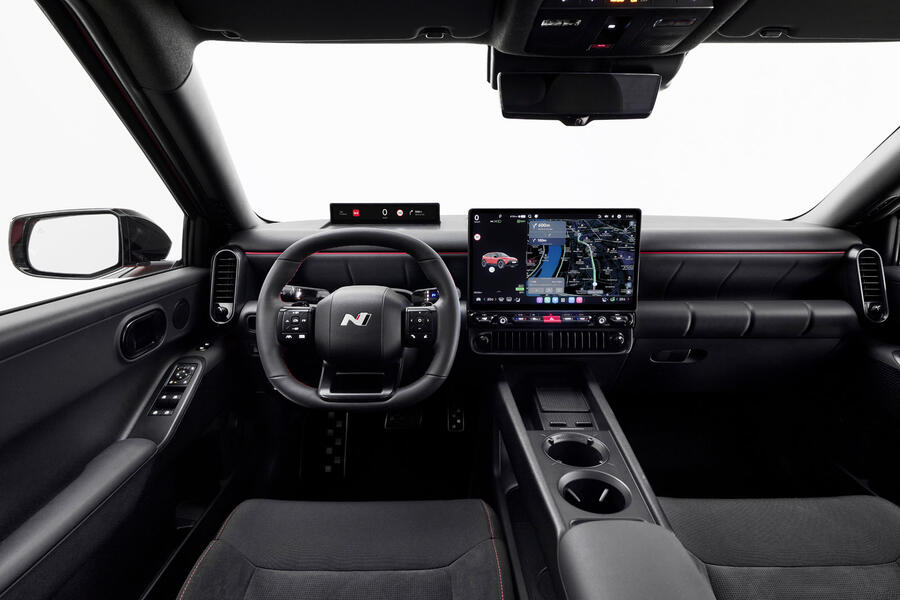
“We place it above the steering wheel, not inside the steering wheel, as in a conventional car,†said Andrean. “That is a huge statement on lifting your eyes and your head up; you are looking a couple degrees higher [when looking at the panel]. This is way closer to the road.â€Â
The Ioniq 3’s 12.9in infotainment screen is also the first to use Hyundai’s new, Android Auto-based Pleos operating system. This will allow new functionality, such as installing apps natively in the car rather than using smartphone mirroring – although that is still included. Positioned below the screen is an array of physical climate control and media switches.Â
“The tactile feel of buttons is very important, and I think [the European] market really needs that,†said Andrean.Â
The Ioniq 3 will arrive in the UK this summer. Standard Range cars will use a 145bhp motor, for a 0-62mph time of 9.0sec, while Long Range cars will get a more efficient 132bhp variant. Hyundai has yet to disclose a peak charging rate but has confirmed the 10-80% refill time will be 29 minutes for the Standard Range car and 30 minutes for the Long Range car.Â
It is not known whether a hot N version will join the line-up as a rival for the Alpine A290 and Volkswagen ID Polo GTI, although Schöttle said he “always sees potential for something more sportyâ€.
Â
How Hyundai has reinvented the cupholder
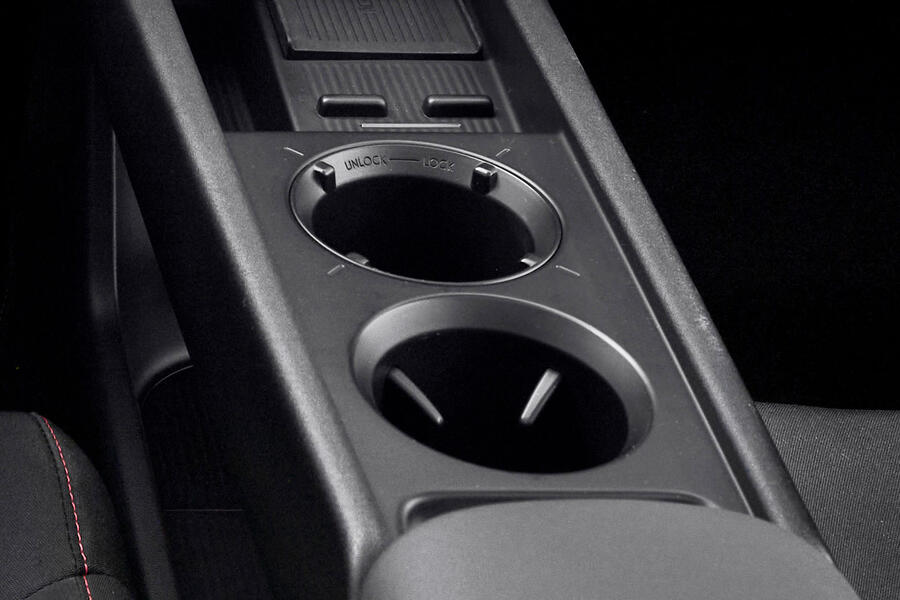
Wary of customers carrying ever-larger flasks, Hyundai has come up with a novel cupholder design that allows for particularly tall receptacles to be stowed in the centre console.Â
The modular cupholders continue through the lower shelf of the centre console, allowing their size to be changed depending on how large a drink the driver or passenger wishes to carry.Â
“We had this question from the very start,†said lead interior designer Victor Andrean. “Where do you put your huge Thermos? These days, everyone is walking around with 1.5-litreplus bottles – I’m one of them.â€