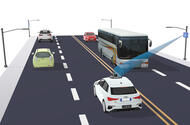
Researchers created a virtual road to test how traffic affects 5G signals and responses
Wireless communication will play a major part in transport systems generally and on the roads 5G will be important in enabling future intelligent transport systems.
But one potential issue is that even 5G, the world's fifth-generation wireless technology, can be blocked for a moment by anything from pedestrians and vehicles, according to research by the University of Glasgow and Heriot-Watt University in Edinburgh.
Their study was carried out for TransiT, a UK-based collaboration of eight universities and around 70 industry partners working on the decarbonisation of transport using digital twins. Digital twinning replicates the physical world using data collected from real-life situations in real time. The digital twin can then analyse that data and send back its solution for an improved outcome in the real-world situation.
Major advantages of 5G over previous methods of data transfer like 4G and even wi-fi originally used in V2X (vehicle to vehicle or infrastructure) are greater reliability and low latency – a substantially shorter time between a command being given and a response being received.
Six years on from the rollout of 5G beginning, the development of driverless vehicles is evolving rapidly and the data transmission they will to some extent rely on needs to be robust.
To investigate how traffic affects 5G's performance, researchers created a virtual 160m stretch of urban dual carriageway. Their detailed simulation included CAVs (connected and autonomous vehicles), which send a continuous flow of high-resolution data from sensors such as cameras and radar to their control centres using high-speed, two-directional communication links.
The team also modelled conventional cars, vans, trucks and buses driving at speeds of between 10mph and 70mph to see how the 5G performance would be affected in low, medium and high levels of traffic congestion. In addition, they investigated how increasing the number and height of 5G radio units attached to lamp-posts would affect signal quality.
The results showed that when congestion was high, the main 5G signal link dropped by around 20% compared with light traffic. The researchers think this could cause delays in sending sensor data or even force vehicles to fall back on slower 4G networks.
The good news is that raising the height of the roadside units in the simulation reduced signal blockages and at 11m all blockages disappeared from the test results. Raising them too high weakens the signal, though, so striking the right balance is crucial.
Increasing the number of roadside units helped in some cases but not others, suggesting that smart planning and coordination is needed due to the sensitivity of 5G signals.
The researchers hope their work will provide valuable insights for network operators and designers building the next generation of intelligent low-carbon transport networks and that the use of AI may help to predict 5G signal disruption.