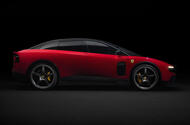
Mega EV is shaped by the wind - but Merc and others have learned luxury buyers don't want efficient
Efficiency isn’t sexy. And the new electric Ferrari Luce is not efficient, at around 2.7kWh per mile based on its predicted range of 329 miles from the 122kWh battery. The trouble is the Luce looks efficient.Â
We’re told the five-door EV has the lowest drag coefficient of any road-going Ferrari. That’s easy to believe studying that soap-bar slipperiness.Â
However, as one automotive exec working in China commented, the car is unlikely to do well there because it looks like it would save you money.Â
Perhaps Ferrari should have amended founder Enzo’s (supposed) saying: aerodynamics is for people who can’t build engines.Â
Electric efficiency is for volume models. Excellent aero is (mostly) a design compromise to increase range without adding more cells. Or use a cheaper, less energy-dense chemistry.Â
Luxury brands don’t need to compromise like that. Jam in the biggest, high-spec battery and ultra-fast charging, and you can demote aero efficiency in favour of the dramatic styling favoured by more traditional ICE aficionados: blocky SUVs or high-downforce supercars.Â
Sportier brands like Ferrari have to worry about a car’s weight but battery energy density rates are climbing fast, bringing lighter packs.Â
Mercedes-Benz was the first to realise that wind-cheating EV shapes used on the EQS limo and other top models didn’t resonate with enough high-end buyers. Better to standardise styling across ICE and EV models and let the fast pace of electric technology cover the shortfall in aero drag.Â
Batteries are already sufficiently cheap and energy dense for Chinese brands to offer 5m-long electric SUVs with enough range to entice luxury buyers. Brand differentiators in China are moving to new frontiers such as automated driving. Excellence in range and charging is now a given.Â
The Luce feels like it was designed in another era, when range was king and you had to differentiate this new, tech-forward propulsion technology.Â
There are some market differences. A heavy EV in China can extend range as start-stop urban driving boosts energy recovery. Europeans are more likely to drive cross-country at speed for longer. A slippery shape will increase those distances without charging. It also suggests the EV tech under the body is still playing catch-up.