Combustion is alive, well, and still relevant thanks to this Renault-Geely firm's innovative approach
Horse Powertrain is notionally a new company, but its roots stretch right back to 2010, when China's Geely acquired Volvo from Ford and united two disparate combustion engine development programmes under one umbrella.
Rather than winding down the existing ICE programmes, the two firms bucked the wider industry trend towards all-out electrification. Instead, they invested in and expanded the division, in recognition, says Horse Powertrain CEO Matias Giannini, "that they were going to need combustion engines to continue to be better and better for a long time".
Giannini continues: "I commend them for having that vision when many other OEMs were basically saying 'leave it alone, let's just focus on EVs, because EVs are going to accelerate very quickly, combustion engines are going to die and we don't need to do anything there'".
Just over a decade later, like-minded Renault Group boss Luca de Meo spun off his own firm's ICE programmes into a similarly conceived stand-alone business called Horse, which would soon after join forces with the Geely-Volvo outfit to create Horse Powertrain - initially owned 50:50 by Geely and Renault but now with a 10% stake taken by Middle Eastern oil giant Saudi Aramco.
With around one billion cars expected to still be powered by a combustion engine at the end of the next decade, Giannini says there were two options for the industry: "Either you just do nothing, and half of the vehicles out there will just have highly inefficient systems, polluting and costing more. Or somebody has to take care of that. And we decided we're the company that's going to help take care of that."
And so that is exactly what Horse is now doing, with 25 manufacturers already signed up to take its engines, including brands from the original founding groups, along with Mercedes-Benz, Nissan and Caterham, to name a few, and discussions are under way with many more.
In fact, Giannini says: "It's hard to pick a top-15 OEM that we're not talking to". That fact alone is testament to the universal applicability of Horse's business model and products, and why the firm is a deserving winner of this year's Sturmey Award for innovation and achievement.
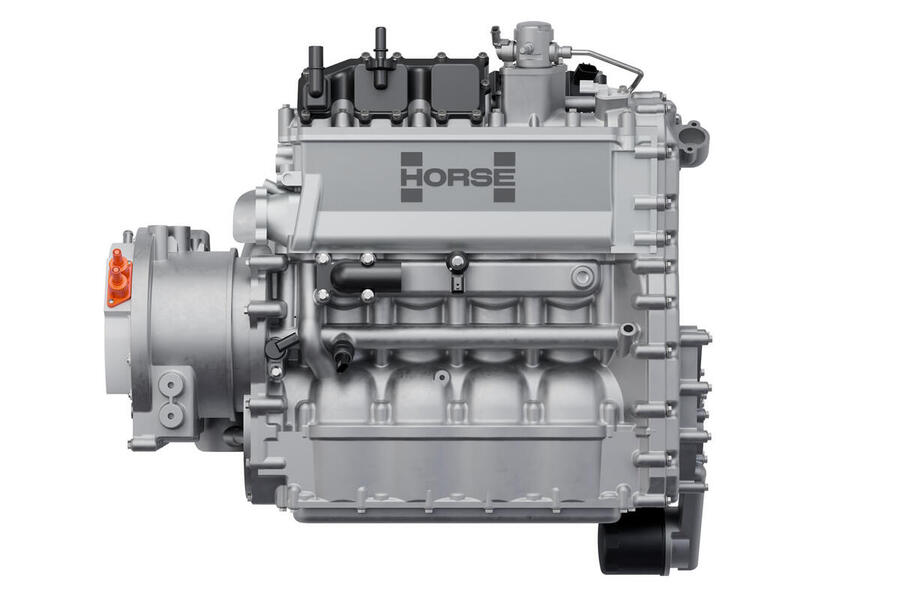
Horse already had a comprehensive range of Volvo-, Geely-and Renault-derived systems on its roster when it was born, and it has since launched in rapid succession a range of its own ultra-frugal, compact, low-cost-oriented engines and hybrid systems.
Perhaps the most significant of these new systems is the 'X Range', which comprises an array of distinct powertrains serving different purposes, but all of them have the same essential goal: turning an EV into a hybrid as easily as possible, with no incursion into the cabin space, no need to carve out more space in the floorpan and a minimal addition in weight.
One of these set-ups, the new C15 petrol range-extender, is so light and compact that it has been dubbed 'the briefcase' engine. It has cleverly been designed to fit in the same vertical space as a battery: it fits perfectly into the space that is freed up in the floorpan of the REx version of any given EV, which doesn't need so much battery capacity due to its on-board back-up generator.
It's a rule-breaking approach that challenges almost every established way of thinking in the automotive game - as technically innovative as it is commercially disruptive. But the question has to be asked: for how long can Horse keep galloping? Irrespective of the ultimate timeline, the plan remains that one day everyone will drive an electric car - and what happens then to a company that has put combustion engine technology at the heart of everything it does?
Giannini grins: "I think that is so far away that I see the opportunity and the obligation that a company like ours has to solve the problem of decarbonisation in the meantime. It is big enough to motivate this company to continue to do what we're doing".
More than 150 years since the first internal combustion engine clattered into life, there's still a long way to go before we achieve peak ICE, he suggests: engines can always be more efficient, quieter, more compact, lighter, capable of running on more different types of fuel... The industry should not stop innovating on the basis that one day the end will come, argues Giannini, and certainly Horse is only just getting into its stride. He adds: "We're not stopping. We're going to keep pushing the limits of technology and finding new ways of doing things."