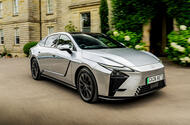
Lexus's eighth-generation ES becomes its one and only big executive saloon – and goes all-electric to boot.
Lexus is one of those car brands that slowly seems to be morphing into an SUV specialist almost by force majeure rather than by force of will. At no point has this firm vowed to stop making other sorts of cars or expressed any particular commitment to becoming a tougher-looking, more outdoorsy version of its former self (unlike some other brands we could mention). It’s simply that customers clearly like SUVs - and Lexus can hardly be criticised for catering to that.Luckily for those who don’t like those SUVs so much, the brand’s management recognises the obligation of a broadly based premium car brand, which sees itself as a rival to the big European ones, to offer a proper range of models. And, just as clearly, said model range should include a big executive saloon like the subject of this review: the Lexus ES. Of course it should. Frankly, it’s hard to imagine Lexus without a generously sized ‘luxury flagship’ four-door. For decades, the full-size Lexus LS was the car indelibly associated with the firm, since it was famously Lexus’s introductory model - in the UK market, at least. In North America, however, the smaller ES appeared at the same time, in 1989. It wasn’t until the seventh-generation ES came along, in 2018, that Europeans and Brits became acquainted with it.Now, the eighth-generation incarnation seems to be part of something of a reset for Lexus’s executive saloon-car strategy. Why a reset? Because by the time it left UK showrooms at the beginning of 2025, the larger, fifth-generation LS had become a very slow-selling car indeed (only three examples were registered in 2024 and fewer than 40 since 2020).It has been replaced, in part, by the firm’s chauffeuring-spec luxury MPV, the Lexus LM. But the old LS also has a kind of successor in this new ES, which is significantly larger than the seventh-generation version; now has a more clearly focussed luxury brief than it ever used to; and has one, but only one, powertrain, albeit one that business and fleet users might naturally gravitate towards in 2026.
