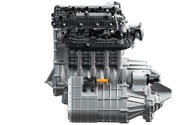
Fifteen months after revealing its plans for 'off-the-shelf' range-extender and hybrid powertrains, Horse Powertrain unveiled its Future Hybrid Powertrain solution earlier this year.
Available from 2027, the "all-in-one" powertrain is aimed at enabling a vehicle manufacturer to easily convert a BEV platform to a hybrid by replacing a front-mounted BEV drive motor and transmission with a hybrid unit.
Two different versions are available: the 740mm wide Performance, which incorporates two electric motors one on the engine output shaft and another on the transmission output shaft; and the 650mm wide Ultra-Compact, which has an electric motor between the engine and transmission.
Horse is also looking at a three-cylinder version, which cuts 70mm from the total width of the unit compared with the new four-cylinder set-up.
The Performance and Ultra-Compact form part of Horse Powertrain's X-Range family, which the firm calls a "category of solutions designed to enrich EV platforms with combustion and hybrid technology".
Both variants use the same 1.5-litre four-cylinder engine combined with a hybrid transmission and a full suite of power electronics that can integrate with other electrical systems, such as a DC/DC converter for stepping high voltage down to low voltage to power the usual vehicle ancillaries, an on-board charger and an 800V charging booster.
The units are installed transversely and have a slimline profile at the top and a wider profile at the bottom to comply with crash regulations. They can be used simply to convert a BEV to hybrid front-wheel drive, or combine with a rear-axle-mounted electric motor to create all-wheel drive. Both the Performance and Ultra-Compact can be employed to create a full hybrid, plug-in hybrid or range-extended EV.
The packaging of the units has been designed to reduce the front overhang by up to 150mm compared with a conventional hybrid powertrain. The unit is mounted on the existing vehicle subframe in the same way as the electric drive units it would replace, the aim being to use as many of the original BEV parts as possible and streamline manufacturing.
Horse says the compact design of the units allows ancillaries like heating, ventilation and air-con systems often located in the front motor compartment of an EV but not in a hybrid due to the size of a conventional hybrid powertrain to remain in place.
Both hybrid engines can run on petrol, E85 ethanol flex fuels, M100 methanol or synthetic fuels. Dedicated EV platforms modified by adding hybrid drives would not originally have been designed to accommodate fuel tanks, but Horse says a tank could be packaged into the space liberated by substituting an EV battery for a much smaller HEV or PHEV battery.