
Recent Updates
03/21/2026 12:00 PM
It's not 'fine', actually: Why should drivers pay for bad road design?
03/21/2026 12:00 PM
Subaru e-Outback
03/21/2026 12:00 PM
"Essential is cool": The mountains and military vehicles shaping Dacia
03/21/2026 12:00 AM
Hyundai Tucson Mk3: The ultimate sub-£5000 family workhorse
03/21/2026 12:00 AM
How to diagnose wheel alignment issues before it’s too late
03/21/2026 12:00 AM
Fuel prices are up 19% in two weeks. What will bring them down?
03/21/2026 12:00 AM
Official: Gerry McGovern leaves JLR to start consultancy
03/21/2026 12:00 AM
I arrived in the UK with a bike – now I own a £225k Aston
03/20/2026 12:00 AM
Seat and Cupra Ateca pulled from UK after decade on sale
03/20/2026 12:00 AM
Jeep Compass
EV, Hybrid, Hydrogen, Solar & more 21st century mobility!
 We join designer David Durand for a weekend in the alps to find out how this budget brand became so fashionable
The original plan for this feature was to meet David Durand a few miles west of Paris for a chatty trudge through some leafy woodland, before settling down next to an idyllic babbling brook for a light lunch and some snaps of us basking cheerily in the sun.
No dice. If we're to really find out what makes Dacia's design boss tick and dig deep into his vision for the brand, we need to aim higher. About 1830 metres higher, in fact, as he jovially remarks when he greets us halfway up a frigid, snow-covered Alpine pass overlooking Lake Annecy in the French Alps.
We've come to join the passionate outdoorsman for a relaxing couple of days in what he calls the "fresh air" (we'd call it bracing) so he can show us the sorts of environments and pursuits that have inspired his repositioning of Dacia as a maker of lifestyle-flavoured, activity-focused family cars that major on utility but without compromising a jot on 'cool factor'.Â
It's a theme that's tricky to fully explore in the confines of a motor show hall or a gently heated design studio, so he's invited us to the mountains he grew up on to demonstrate what it's all about.
"For me, this is the perfect place," says the keen sailor, cyclist, runner, climber and skier – not just for showing off the Dacia brand ethos but also because of the connection he has with the area. "It's not the only place we could go, but for me it comes to my mind immediately because I'm from here. These are my roots," he says.

Grenoble-born Durand is a Renault Group lifer. Joining the firm fresh out of college 29 years ago as an exterior designer, he made a name for himself with the rule-bending Koleos concept at the turn of the millennium and the wacky Ellypse, which previewed the Modus, two years later.
A subsequent stint in Renault's satellite studio network included spending time with the design teams in Barcelona, Seoul and São Paulo, before he returned to base to take a leading role in shaping and positioning the Dacia brand.
As exterior design director in 2020, Durand shaped the Bigster concept, which previewed a chunky new 4x4-flavoured direction for the wider line-up and he's been evolving that since becoming overall design boss four years ago, emphasising the brand's no-nonsense approach by cultivating a rugged, outdoorsy image centred on the straightforward, intuitive practicality credentials of the cars themselves.
It was a dramatic shift for a brand that had hitherto been known, and celebrated, almost exclusively for its budget-friendly billing, with its cheapest models marked out by diddy steel wheels, black plastic bumpers and blanked-off centre consoles – and Durand says the revamp was a crucial component of former group CEO Luca de Meo's transformative 'Renaulution' reinvention strategy.
Durand recalls: "He arrived with a fresh eye, saying: 'You can't imagine how the other groups envy you with the Dacia brand. Everybody is trying to copy it, but they can't manage to do it. The only thing missing is that the brand could be a bit more attractive."
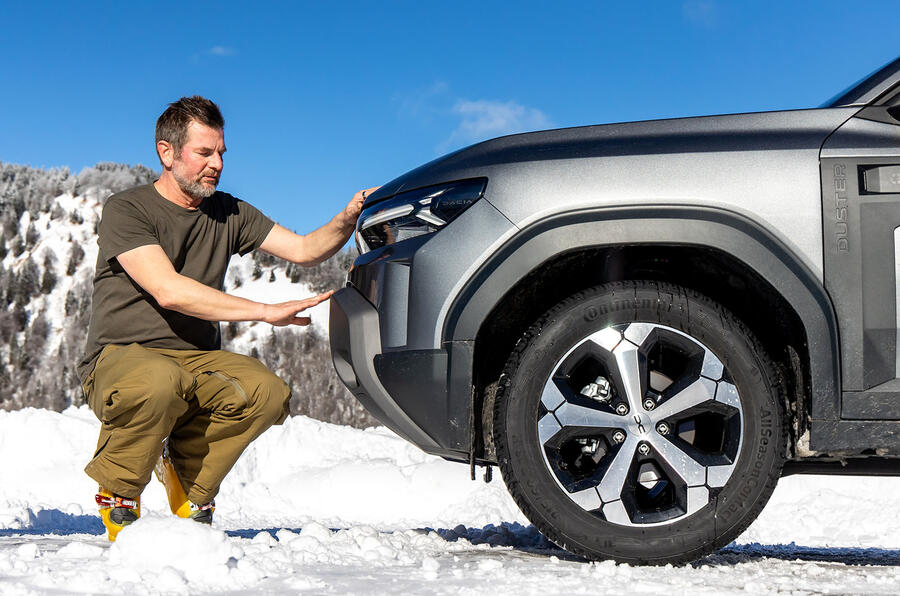
"So we started thinking: how could we stay with our DNA, but make it more attractive? And it came out that essential can be cool."
This was a true light-bulb moment. Dacia's cars were already "appreciated for the capacity they had", remembers Durand, "but we never claimed it.
"That's why we pushed the outdoors," he says. "It matched so well with our products. We realised that for a lot of outdoors activity, you need a car to go and do it. It's a tool; your real activity, and your real fun, starts from the point you stop, but in between you have the perfect tool to be able to do it."
Handily (and brilliantly), our hosts use an old Steyr-Puch Pinzgauer 6x6 troop carrier to get around the mountain in winter and Durand is only too keen to drag it out of their garage to uphold it as a shining example of how function can shape form.
Bounding around this intimidating six-wheeler, he picks out a raft of clever concessions to utility that can inform a more ergonomic and cost-efficient approach to modern automotive design.
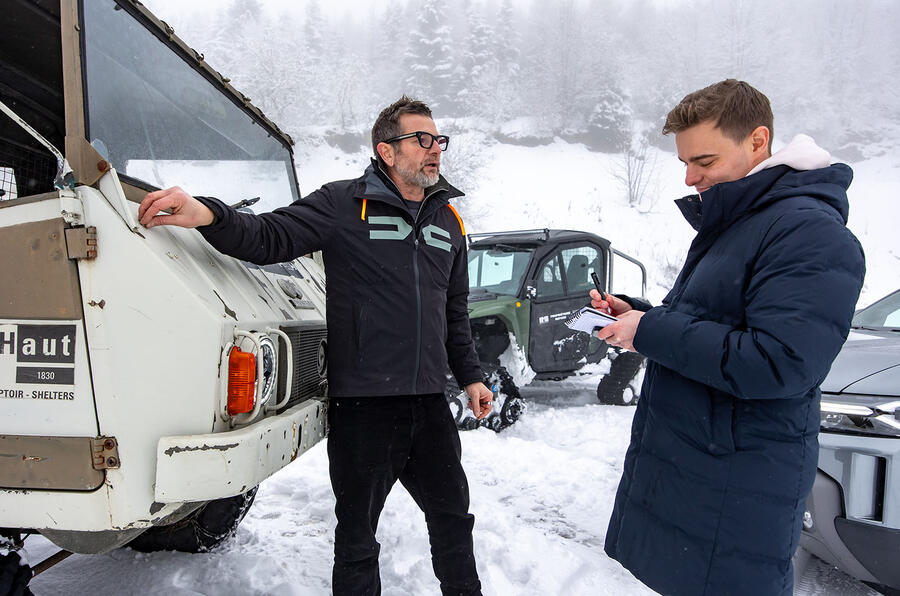
"Look at how beautiful this handle is!" Durand exclaims adoringly as he runs his hand over the unassuming circular cut-out for the interior door pull, marvelling at how noninvasively and cheaply it has been integrated into the bodywork while still being essentially unimprovable in its capacity to simply operate as intended. "It hasn't been designed. It's really functional," he says.
The folding front seats are a highlight too, irrespective of how scantily upholstered they may be – "everything is easy to access and you accept that it shows the structure" – and hark at how the uncompromising benches in the rear come together to form a massive bed.
He also highlights the protective wood cladding on the side as a simple ("crude", even) but forward-thinking and cost-effective means of bolstering capability while adding character. "You know that you are going to slide on trees or rocks, and it avoids the vehicle being damaged. Plus it's easy to change," says Durand.
An idea for the next Duster, maybe? "Why not!" "What's always interesting for us, when we are talking about essentiality in our design and robustness, is the military rule to building vehicles: everything is only functional.
"You have absolutely no decoration," he explains, fawning over the exposed screw heads in the bodywork, visible chassis structures and exposed hinges.
"Okay, it's super-extreme and it's not really comfortable," he admits. "Everything is quite hard. Everything is visible. But, crucially, everything has a purpose: if it's there, it's because it needs to be."
There's a difference between leaving something half-finished and leaving it unfinished, and the latter can – perhaps counterintuitively – help to emphasise a car's robustness and fitness for purpose, while obviously saving money in parts and labour, and making damage easier to repair.
"When we go back to basics, it reminds us that showing a screw is not a crime. It's acceptable because you are saving a cover and weight and money. It's what you want," says Durand.
Beyond these intriguing quirks and features, though, there are more tangible parallels to be drawn between this military-bred curio and the modern-era Dacia.
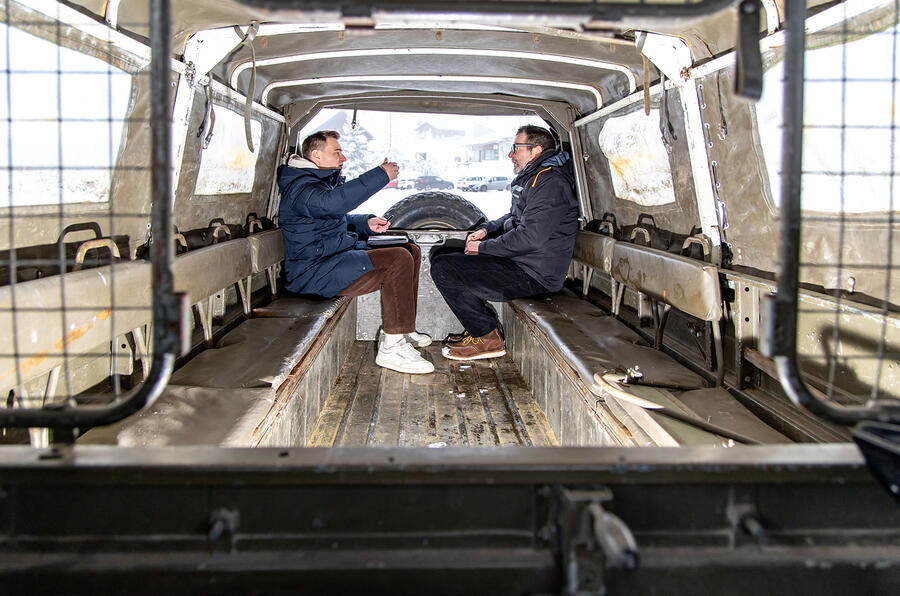
Durand points to the Pinzgauer's steeply chamfered lower quarters – essential for maximising approach and departure angles – as a defining characteristic of its design and one that he has reinterpreted in the Duster as a means of not just enhancing its off-road credentials but also emphasising the brand's pretensions to rugged dependability.
"It creates trust – the fact that the brand is honest and it's just telling the truth," he says. "There is a kind of honesty" in having a car that looks like an off-roader and can actually go off-road.
It's an attribute accentuated by various hexagonal motifs throughout the Duster's design, including the air-vent surrounds, the straight-cut wheel arches and even the sharply angled Dacia logo. These features echo the 4x4-inspired flat surfacing and bluff angles of the bodywork itself, which, says Durand, has evolved to become "quite a recognisable formal language" for the brand.
Obvious comparisons with the likes of the original Land Rover Defender and Fiat Panda 4x4 are more than welcome, he says, because of the similar characteristics he wants people to associate with his designs.
These humble and unpretentious icons, says Durand, are revered for being "simple, affordable, essential, popular and super-good in all conditions and very appreciated by real users", rather than simply being "show-off crossovers with no ability outside of the roads" – a legacy he cites as a major influence on his shaping of the Dacia brand.
The Duster and Bigster SUVs are the most obvious beneficiaries, but he says even the lower-slung Sandero and Jogger - as well as the electric Spring city car and the two new C-segment models coming to Dacia dealerships over the next year – should equally convey this air of unflappable utility.
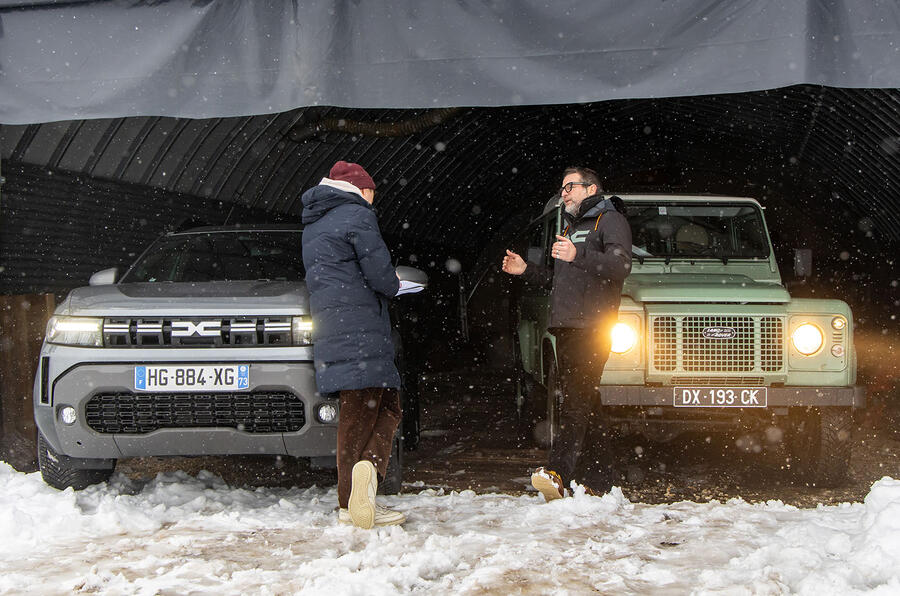
It all comes back to the rigid policy of 'essentialisation' that underpins the Dacia brand as a whole – an ethos that, Durand explains while gleefully whizzing us to our overnight accommodation at the top of La Sambuy mountain in a UTV, is heavily informed by the works of renowned German industrial designer Dieter Rams.
Best known for his work at consumer electronics giant Braun, Rams is one of the most influential proponents of aesthetic functionalism, which he employed to great effect in the iconic designs of the T2 lighter, the ET66 calculator and the Phonosuper record player – colloquially dubbed 'Snow White's Coffin' in reflection of its monolithic, minimalist surfacing.
In his shunning of unnecessary decoration and the pursuit of a purer and more purpose-led design language, Rams cultivated the emergence of the 'less is better' movement, which lifelong admirer Durand cites as a central pillar of his manifesto for Dacia: "The best design is the design where you have the least design possible."
Beyond design, it's a strategy that also informs the brand's modus operandi of providing 'everything you need, and nothing you don't' in its cars which resonates ever-louder in the context of a market where prices are being driven ever upwards by soaring production costs, increasingly stringent safety and emissions regulation, and the over-endowment of the modern car with costly, complex technology.
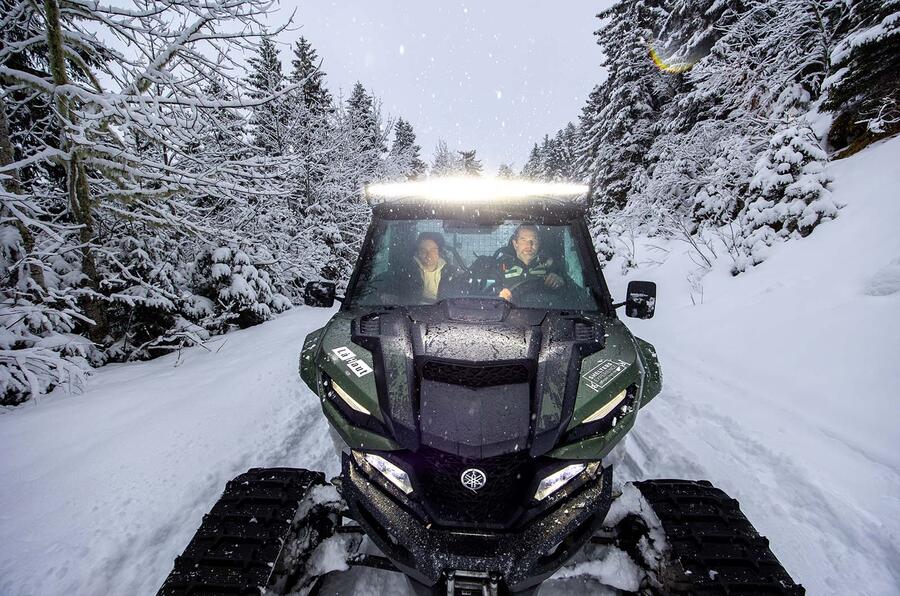
It's also the main reason Dacia interiors still major on physical buttons and switches. Users need to quickly and intuitively know what everything does and it all needs to work for as long as possible.
We return to this theme later that evening when we're shown to the 1960s polar expedition pods that we'll be sleeping in. These tiny, barebones metal boxes, airlifted to their mountaintop perches, are, it quickly becomes clear, basically what a Dacia house would look like.
You can almost see Durand scribbling mental notes as he marvels at the simple gutter rail above the entrances, the ceiling-mounted pull cords for the blinds and the leather door pull straps, which "show that sometimes the old natural materials are still the best".
Everything in here has clearly been designed to keep weight, cost and complexity down, but there's pleasure to be derived and lessons to be learned from how intuitive and functional it all is. "You don't need instructions on how to use it", says Durand as he plays with the clever window locking mechanism and delights in the retro Bakelite controls for the radiator. "You know how it works before you use it."
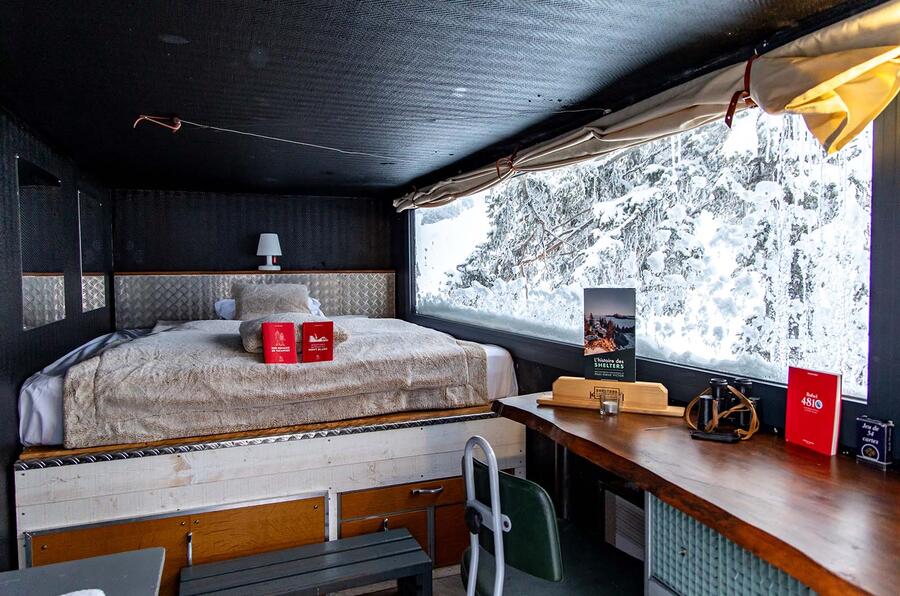
"We must not forget about those very simple ideas that do the job better than ever. Sometimes we are thinking a bit too complex," he says, suggesting that there's no reason these ingenious and charming features couldn't be reinterpreted in a more modern (and NCAP-appeasing) way for future cars.
It's all part of that overarching ambition to make the essential into the exciting, and better cater to the precise needs of Dacia's customers rather than drive the prices of its cars up with features, technology and styling that nobody asked for.
It's a sentiment that's expressed no more clearly than by Durand's muse, Dieter Rams himself, in his famous affirmation that "indifference towards people and the reality in which they live is actually the one and only cardinal sin in design".
And that outlook couldn't feel more appropriate the next morning as we wade through a metre of snow towards the waiting Duster, hurl our tons of luggage into the cavernous boot, knock the slush off our boots on the lower body cladding, turn the heater up with freezing fingers (thank you, buttons), plough easily over the snowdrifts that have accumulated outside the huts and surge confidently down the icy track to the bottom of the mountain, as meltwater pools slowly around our feet on the muddy rubber floor mats.
"If you have good ideas, you can do it"
Over the years, enterprising Dacia owners have come up with dozens of 3D-printed accessories for their cars – cable tidies, can holders, touchlights, key slots, bag hooks... – and Durand says that's exactly the sort of community spirit he wants to cultivate with his designs.
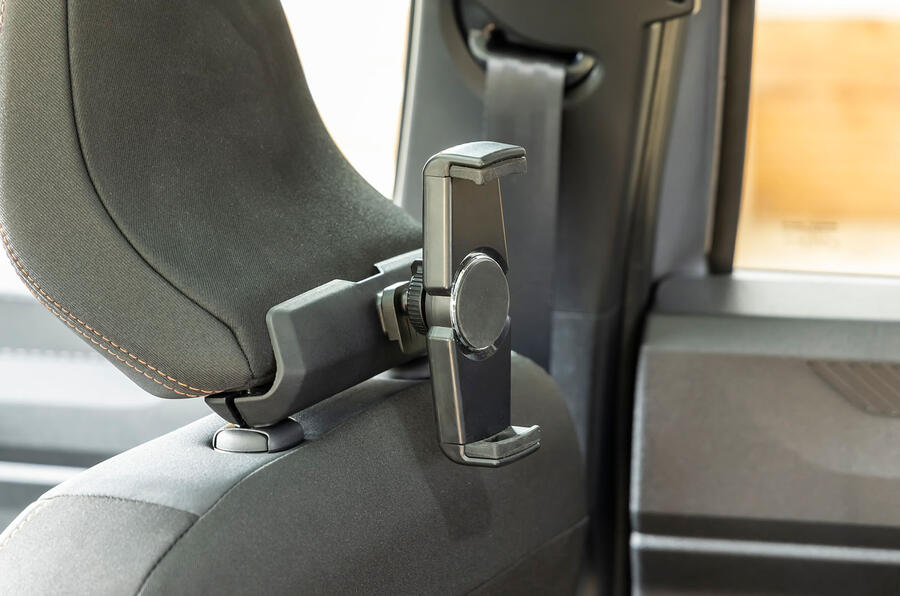
"We have a trust relationship: if you have good ideas, you can do it," he says, proudly remarking that many of these creators make the 3D files available online for others to use and that the phenomenon inspired Dacia to develop the Youclip accessory mounts that now feature throughout its cars.
"There is huge creativity from our customers and we learn from them," he says. "Sometimes they have good ideas because they have a very specific usage, and you see that it's coming from real life."