Chinese-American joint venture will build several new models at Valencia factory, securing its future
A new multi-energy Ford crossover and two Geely EVs will be built in Valencia, securing the future of Ford's Spanish factory.
The deal, confirmed after months of speculation, will involve the creation of the new joint venture that will take over the operation of the factory, which Ford opened 50 years ago.
When the deal is completed next year, Ford will own 66% of the new entity and China's Geely Auto will own 34%.Â
The goal to maximise the plant’s potential annual capacity of around 500,000 vehicles, which Ford of Europe boss Jim Baumbick said will involve hiring additional staff.
What it means for Ford: three models and shared tech
The Kuga SUV is the only model currently produced in Valencia, but four new machines are now set to join it by 2029.
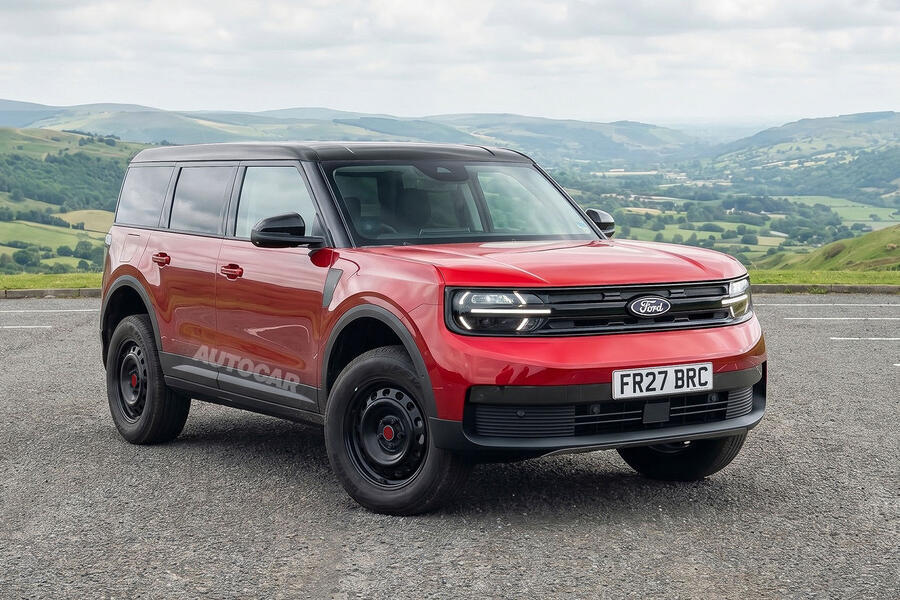
This will include the new European-focused Bronco SUV (imagined by Autocar above), which will arrive in 2028 and is understood to sit on the same C2 platform as the Kuga.
There will also be a new multi-energy Ford “family crossoverâ€, which will be jointly developed by Ford and Geely, also due in 2028. Baumbick said it will be “a rally-bred crossover in the C-segmentâ€.
While he didn’t specify which platform the new crossover will be based on, he said that it won't be a badge-engineered model: “The Ford product will be a completely unique top hat; this is not a reskin.
"We don’t do boring cars. This is a completely uniquely engineered, truly unmistakably Ford product that will be differentiated from Geely’s product.â€
The Bronco and new crossover are two of five new rally-inspired models that Ford plans to launch in Europe by 2029 as part of a major revival plan for the region.
There will also be two small electric models that will be produced by Renault, along with a further multi-energy crossover.
Ford has yet to give any details of that fifth model, but its absence from the initial plans for Valencia suggests that it will be built elsewhere.
Ford’s German plant currently produces the Explorer and Capri electric SUVs on the Volkswagen Group’s MEB platform, and Baumbick said that deal was unaffected.
Meanwhile, Ford also currently produces the Puma in petrol and electric forms in Romania.
What the deal means for Geely
Geely will produce two electric SUVs at Valencia, with production expected to begin in 2028, as part of its global expansion plans.
Although this will be the first time Geely-branded models have been built in Europe, the Chinese company has experience of European production through its ownership of LEVC, Lotus, Polestar and Volvo.
Geely senior vice-president Victor Yang declined to specify which models would be built in Spain but said: “We have always believed that to be truly rooted in Europe, we must be of Europe.
"For us that means localisation and a long-term commitment to integrating our expertise with the world-class manufacturing heritage of the Valencia plant.
“We are doubling down on our belief in European industrial excellence. We aren't here simply to sell; we're here to invest in local talent, to strengthen supply chains and work alongside Ford to deliver the multi-energy solutions European customers are asking for.â€
Yang said that Geely's target is for between a third and a half of its European sales to be produced in Europe within around five years.
How the deal will work
Baumbick said that “we think Geely is very special and this is going to be a really special partnershipâ€.
He explained that this is partly because the history between the two firms dates back to 2010, when the Chinese giant bought Volvo from Ford.
He said Ford considered numerous partners but picked Geely because of “their EV and broad capabilityâ€, continuing: “The reason we're co-developing is to ensure that we have the ability to truly differentiate the products and leverage scale.
“The battle we're in and the environment in Europe has changed forever. It's at a new level of cost. What we're trying to do is ensure that we can actually demonstrate the lowest possible cost while building products specifically in Europe for European customers. It’s no different than what the Geely team is trying to do is to get costs that they see in China actually in Europe, and collectively we're taking choices that are congruent with made-in-Europe.â€
Baumbick declined to say how operations at Valencia would work, given that two of the five cars manufactured there will sit on an existing Ford platform and the others on a shared multi-energy architecture.
But he added: "Our goal is to make sure that we fully utilise this facility, and so that doesn't create any fixed parameters. It gives us the flexibility to ensure that we can optimise this facility. And if you fully utilise it, it gets the lowest cost for everybody. That's the goal."
Valencia's history
Ford opened its Valencia plant in 1976, initially produced the Fiesta hatchback, and it was later home to models including the Escort, Ka, Focus, Mondeo, Galaxy, S-Max and Transit Connect. Kuga production began there in 2013.
With a current maximum production of around 500,000Â vehicles and with 8000 employees, it's Ford's largest plant outside the US.