Unreliability and bad quality scuppered the TR7, but there's so much to love about it
What most people know about the Triumph TR7 of 1974-1981 is that it's a metaphor for the whole British car industry at the time: an adventurous design scuppered by ropey early manufacturing quality that fatally damaged its reputation.
It wasn't a complicated car, just a front-engined, rear-driven roadster with a moderately warm 2.0-litre four-pot engine, driving a live rear axle. Brakes were disc and drum. But its design, the work of a team led by oft-misrepresented Harris Mann, was very progressive: a wedge with an upwardly sweeping swage line, labelled "the shape of things to come".
It sold strongly in the US in the beginning, initially as a coupé and later as a convertible too (after it was established that encroaching American crash safety standards could still allow drop-tops), but the unreliability and bad quality were the big hurdles.
Yet there were great things about TR7s, and I know because I had two of them. Their short wheelbase and relative lightness made them agile, their seats and driving position were brilliantly comfortable, the convertible's top-down protection was exceptional when cruising and they were easy to mend.
My first TR7 was an early convertible with a four-speed gearbox and a busted engine, bought for a song with four flat tyres because it had stood in a north London street for several years. Its virtues were a loud green paint job and the tartan seats my family all liked.
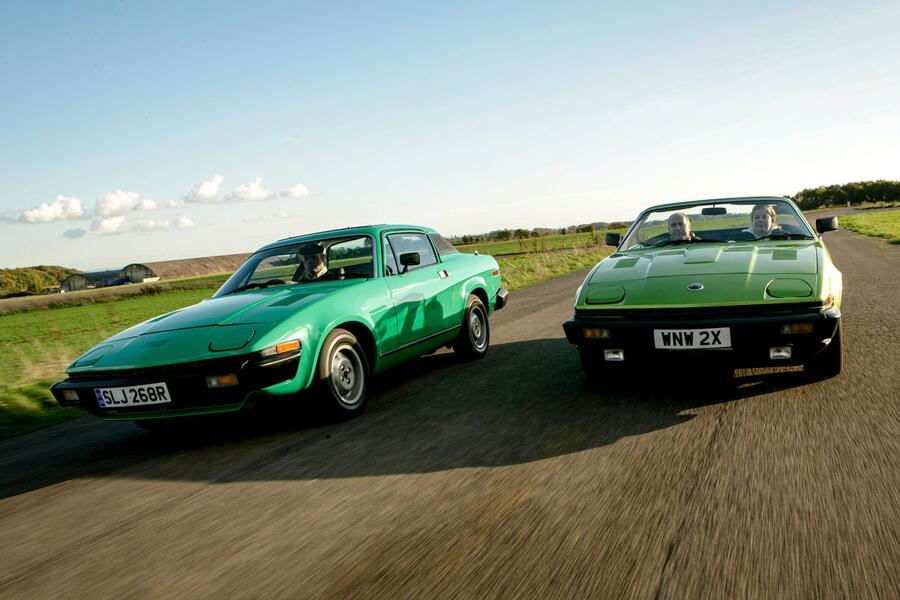
I sent it off to S&S, a now-closed TR7 specialist in Ramsbottom, Lancashire, which fitted an ex-Rover 3.5-litre V8, a five-speed gearbox and a taller-ratio back axle, beefed up the suspension and brakes and gave it back as quite a weapon.
That was circa 1990. I always wonder where that car is now and hope it's still living a happy life, because happy is what it made me, for a year or two.
My second TR7 was a later model in white, also a convertible and a healthy low-miler with the standard five-speed gearbox. I kept it that way, because to change it would have been a shame. It had all the virtues I listed before, plus decent body rigidity and quite taut suspension. Again, I bought it cheaply, because you couldn't pay much in the mid-1990s.
I was persuaded out of it because someone who saw it in the street offered me a £500 profit. I summarily sold it and didn't think much about it for years - until I finally met Mann at a gathering of MG XPower SV owners a few years back and he explained the car's conception and what a birth struggle it had endured, because it was progressive and thus ripe to be misunderstood by 'management'.
Nowadays I wish I had either car, or both, back again, because have pleasant memories of their simplicity and agility, the pleasant nose-heaviness of the V8 and the light steering of the four-pot. I can still feel that gearlever in my hand. Furthermore, TR7s are still good value and the styling, barring a few details, still looks brilliant today.
But most of all I'd like to remember a brave but low-key British designer who believed in progress, rather than in maintaining the status quo, and was content to live with criticism from those who couldn't see as far ahead as he could.
I see TR7s getting scarce now, and I see their prices deservedly strengthening. The trick now is to find unmolested versions. I keep my eyes open, and if I ever see the right car I will be sorely tempted.