
Recent Updates
04/21/2026 12:00 AM
New Mercedes C-Class EV could be saloon-only for first time
04/21/2026 12:00 AM
Hyundai Ioniq 3 is radical £25k 'aero-hatch' to fight Renault 5
04/20/2026 12:00 PM
Smart #2: Concept previews design for Fortwo successor
04/20/2026 12:00 PM
Revealed: Mercedes C-Class EV brings traditional look and 472-mile range
04/20/2026 12:00 AM
New 2026 Polestar 3 driven: Huge tech upgrade - but one big loss
04/19/2026 12:00 PM
Honda CR-Z meets Prelude: Was hybrid coupe misunderstood?
04/19/2026 12:00 PM
Nascars, Soviet tractors and... Tigger? Facebook is a car shopping wonderland
04/18/2026 12:00 PM
My Mini mission to Sweden: A freezing tribute to affordable cabrios
04/18/2026 12:00 PM
Inside Jason Plato's grand plan to dominate the BTCC - again
04/18/2026 12:00 PM
"Councils can do more..." The truth about the pothole pandemic
EV, Hybrid, Hydrogen, Solar & more 21st century mobility!
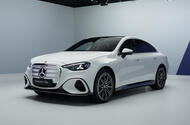 Electric version of benchmark executive saloon apes petrol car's look and is claimed to be sportiest C-Class yet
Mercedes-Benz has hit back at arch-rival BMW with the first electric C-Class – which it claims will be the “sportiest-ever†version of the long-running saloon to take on the recently revealed i3.
As the saloon sibling to the new electric GLC, the C-Class EV is the second car to both use the new MB.EA platform and be designed according to Mercedes’ new strategy of making its electric models look more like its ICE cars.
Due on sale in the UK later this year, the new C-Class will be offered initially in dual-motor 400 4Matic guise, with a range of 472 miles and a sub-£60k list price, before further powertrain options – including long-range single-motor variants and performance versions – are added down the line.
Completely unrelated to the combustion-engined C-Class, which will remain on sale and have its styling tweaked to more closely match that of the new EV, the new arrival slots in above the CLA in Mercedes’ expanding range of bespoke EVs and provides the framework for a larger electric E-Class saloon next year to replace the EQE.
NEW C-CLASS DESIGN
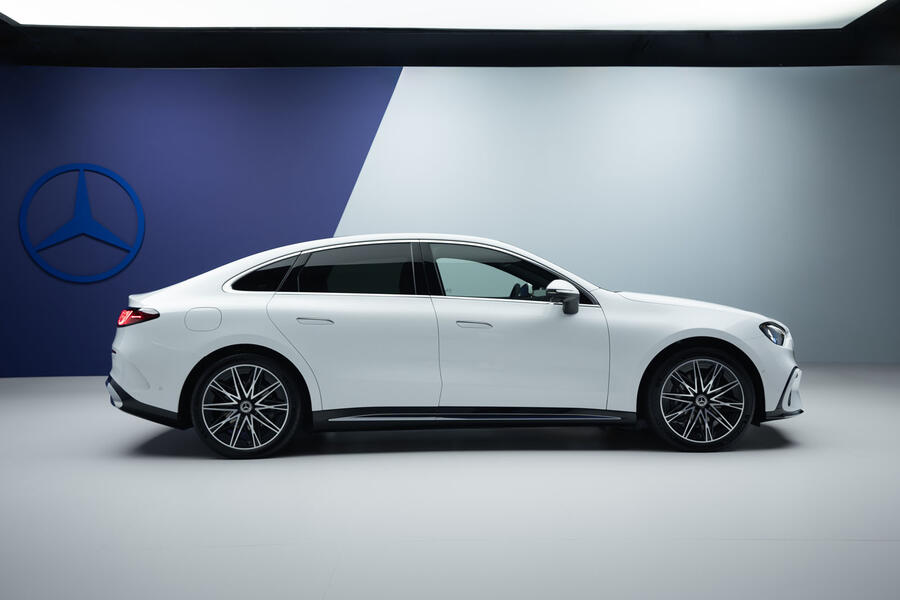
Unlike the EQE and EQS saloons, which have a distinctive cab-forward profile and one-bow silhouette that differentiates them clearly from their ICE counterparts, the electric C-Class has been designed to much more closely resemble its combustion-engined namesake.
Robert Lesnik, Mercedes’ head of exterior design, said the new saloon – and its GLC sibling – represents a turning point in Mercedes styling, and from this point onwards the brand’s cars will not be overtly shaped according to their powertrains.
Referencing Mercedes’ comments at the unveiling of the EQS in 2020, Lesnik said: “We said we will have two different worlds: electric cars will look different. But we turn around and one generation is gone, and we’re talking about the next one after six years, and they come together again.
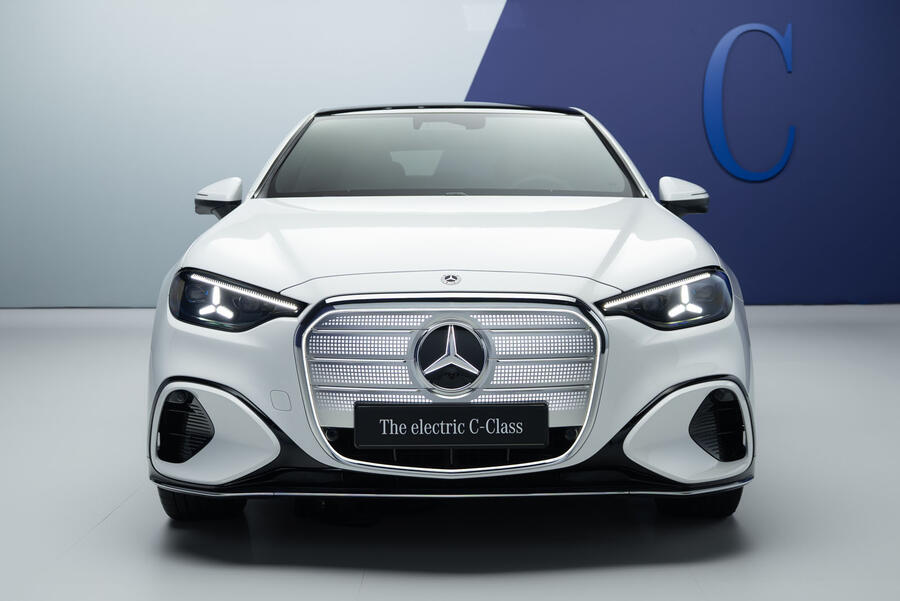
“There is no differentiation between the combustion-engined car and electric car. And this is it: this car has the same-height front end as a combustion car. It’s not lower, like the [electric cars] that we had – it has more status and presence.â€Â
In keeping with that push for ‘presence’ is the huge illuminated grille, which matches that of the electric GLC and, said Lesnik, is designed to help Mercedes models stand out in an increasingly competitive market.Â
That includes the ICE cars, which will also use a version of the new face. Lesnik added: “Icons make the difference in the end, and definitely the Mercedes grille is an icon.Â
“We have some other grilles, they are all iconic: we have the V-shaped grilles with upright struts on the AMG performance cars, we have the horizontal lamellar for the G-Wagen and we even have Maybach. It doesn’t matter which one, if I sketched it with a few lines you would probably recognise it as a Mercedes grille.Â
“This is one of the strongest differentiators to other brands. The world is turning so fast, with so many new brands these days, and most of them don’t have these iconic elements, because they don’t have the heritage.â€Â
Disguising the inherently taller profile of an EV compared with a combustion-engined saloon was a key challenge for the designers, said Lesnik, adding: “If you get a big battery that you have to put somewhere, obviously this will have an effect on the height of the car, so the car is roughly 60mm higher – and the first goal was: how do we disguise that additional height?â€Â
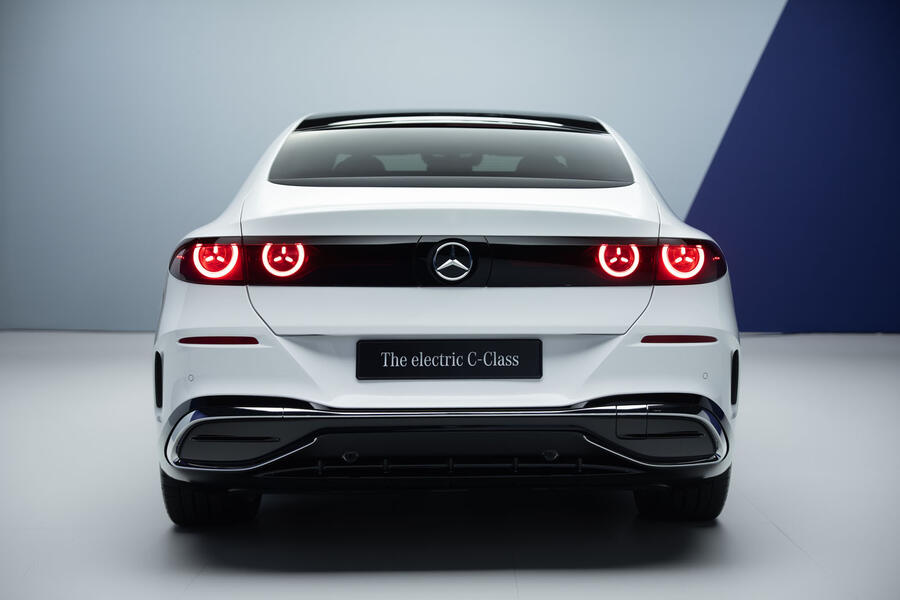
The answer, he explained, was to employ a series of “simple tricksâ€. These include a contrasting trim panel that breaks up the visual mass of the car’s side profile, along with bigger wheels and an extended glasshouse that includes a ‘three-window’ daylight opening – a C-Class first – that flows back into a sleek, rakish coupé-style rear end.Â
Lesnik said this “GT rear endâ€, which marks a dramatic departure from the traditional three-box silhouette of all previous C-Class models, provides a functional role as well as an aesthetic one: “The car will have a very good drag coefficient – I’m not telling you any numbers, I’m just the designer. But it will be very good.â€Â
That’s positive for both refinements – Mercedes says the slippery shell will help to create “an exceptionally quiet interior†– and higher-speed cruising efficiency.Â
NEW C-CLASS INTERIORÂ
The electric C-Class’s cabin is dominated by a 993mm-wide Hyperscreen display, which spans the entire width of the car and is made up of 1000 individual LEDs and offers the ability to individually dim certain areas using a slider.Â
Available as an option, this expansive interface allows front passengers to use streaming services, play games and control various in-car systems when the car is in motion, while presenting navigation, audio and climate menus to the driver.Â
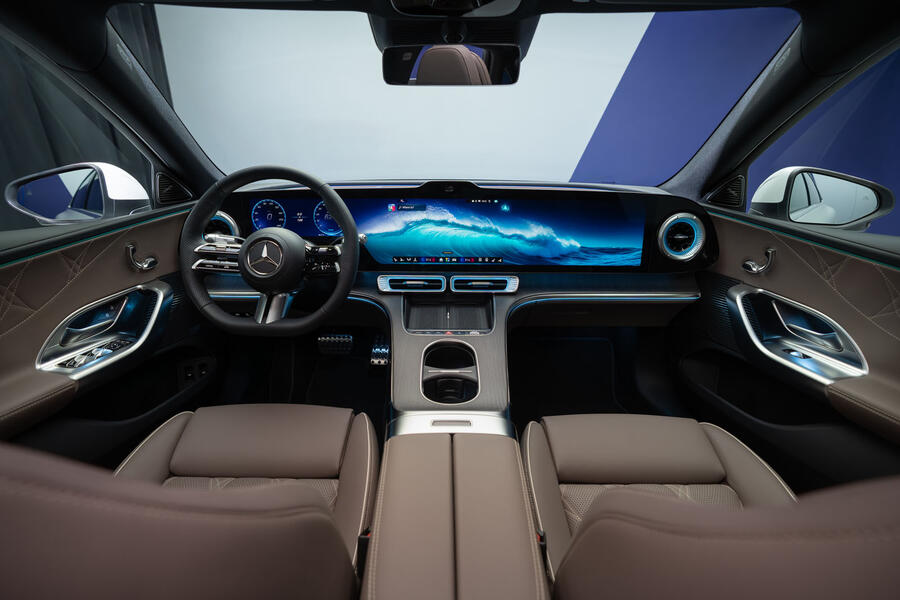
As standard, the C-Class will have a less dramatic Superscreen arrangement, which is based on the same layout but has three separate screens, with the passenger’s display being invisible to the driver to minimise distraction. Both systems run the latest version of Mercedes’ MBUX infotainment platform, which uses AI technology from ChatGPT, Google Gemini and Microsoft in a “unique multiagent approach†that, said Mercedes, “revolutionises the relationship between the vehicle and the driverâ€.Â
Using voice control, it can be spoken to “like a friendâ€, said the firm, being capable of complex, multi-part conversations and retaining a short-term memory.Â
Despite the heightened emphasis on digital functionality, the electric C-Class retains a suite of physical controls in line with a push to maximise analogue appeal.Â
There is a new control panel on the centre console, for example, with buttons and a roller for volume control, while the steering wheel hosts rocker switches for the speed limiter and cruise control functions.Â
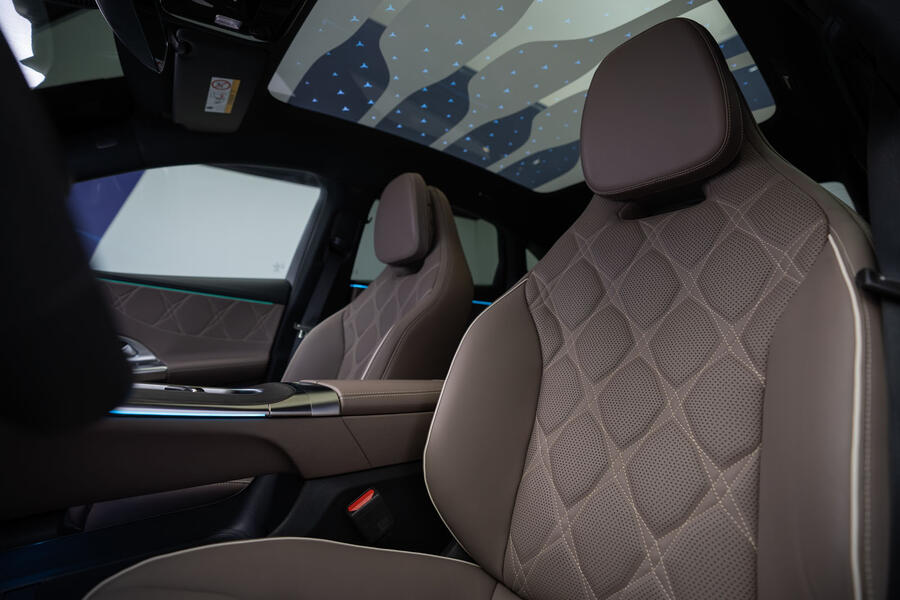
While the EV is a similar size to the combustion-engined C-Class, at around 4.8 metres long, it has a substantial 97mm of extra wheelbase for improved leg room, which, said Mercedes, is testament to the greater flexibility afforded by a bespoke EV architecture.Â
A higher roofline, meanwhile, means there is also more head room in both rows – 22mm extra in the front and 11mm in the rear – despite the underfloor battery.Â
Boot space is pegged at 470 litres, which is slightly up on the fuel-burning car, and there’s a 101-litre cubby beneath the bonnet, for charging cables and muddy boots.Â
WHAT'S UNDERNEATH THE NEWÂ C-CLASS
As with the electric GLC, the electric C-Class will be launched first with the dual-motor 400 4Matic powertrain, which makes 483bhp and 590lb ft for a 0-62mph time of 4.1sec – as quick as an old V8-powered AMG C63, for reference.Â
Power is stored in a 94.5kWh underfloor battery pack, which is good for a claimed range of 472 miles. The C-Class is equipped with 800V hardware for charging at up to 330kW, meaning it can gain 199 miles of range in just 10 minutes, said Mercedes.Â
This means the C-Class can theoretically “cover well over 1000km [620 miles] with just one brief charging stop†– roughly equivalent to the distance between Dundee and St Ives.Â
The C-Class will be offered with a 400V inverter so it can use lower-powered public chargers, such as those that are more common in the UK.Â
Future additions to the range include a lower-powered rear-wheel-drive version, which will offer a range of around 500 miles, while other battery and power output options will be rolled out later on.
As reported by Autocar, the C-Class’s GLC sibling is in line to be released in hardcore tri-motor AMG performance guise, and it is likely that the four-door will follow suit, in effect giving an electric successor to the C63 – and a rival to BMW’s upcoming quadmotor ‘iM3’ super-saloon.Â
The electric C-Class is technically identical to the GLC underneath. It is based on the new MB.EA platform that Mercedes-Benz has developed for midsized EVs and which is unrelated to both the MRA platform underneath the combustion-engined C-Class and the smaller MMA architecture that underpins the smaller CLA and GLB EVs.Â
Mercedes is calling the new model “the sportiest C-Class everâ€. It touts the refinement and dynamic credentials of the new underpinnings, which are said to offer cruising comfort on a par with an S-Class, while being capable of “attacking every curve with unrivalled agility and precisionâ€.Â
Central to the C-Class’s dynamic character are the optional Airmatic adaptive suspension system, which uses real-time cloud data to prime the chassis for upcoming potholes and speed bumps, and the rear steering, which turns the back wheels at up to 4.5deg in either direction to boost both high-speed stability and low-speed agility.Â
Other features new for the MB.EA platform include a two-speed gearbox for the rear motor to ensure optimum acceleration from all speeds while maximising efficiency at a cruise. In 4Matic models, this rear set-up is supported by a front axle-mounted additional motor that kicks in only when needed – depending on throttle load and drive mode – to give full power.Â
It remains otherwise disconnected from the drivetrain, which is said to reduce energy losses on the front axle by up to 90%.Â