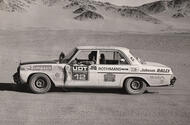
After the inaugural World Cup Rally was a huge hit, the 1974 follow-up hit trouble in the Sahara desert
The 2026 World Cup is currently taking place across North America. You might have heard about it; apparently this football stuff is quite popular.
Anyway, Mexico is one of the three hosts of this year's tournament (alongside the US and Canada), making it the first country to stage the event on three occasions. The World Cup was first held in Mexico in 1970, four years after it took place in - and was won by - England. To celebrate, the RAC and Motor Sports Association dreamed up an ambitious event: the World Cup Rally.
Running for close to five weeks, the route spanned some 16,000 miles, including a boat crossing over the Atlantic plus another to sidestep the Darién Gap in Panama, from Wembley Stadium to Mexico City.
It was a huge success, attracting public interest due to the participation of Prince Michael of Kent and Jimmy Greaves, while Hannu Mikkola's famous win in an Escort RS1800 was the inspiration for the Escort Mexico.
But that event is so well known it barely needs recounting here: less well remembered is that four years later, when the World Cup was held in Germany, the organisers decided to run the rally again.
Because the RAC was organising the event, London was chosen as the start venue (although this time it began at the Royal Opera House, a venue not known for deep football links), and the finish was set for the Olympic Stadium in Munich. Given that the two cities are fewer than 600 miles apart, some imagination was required for a multi-week marathon rally.
And so the event, which ran from 5-25 May, covered some 12,000 miles via a looped route that went through France and Spain before crossing to Morocco in Africa. It then headed into the Sahara Desert, passing through Algeria, Niger, Nigeria, Libya and Tunisia, before returning to Europe through Turkey, Greece and Yugoslavia and then, finally, entering Germany.
Predictably, the stages in the Sahara proved pivotal for the rally - and dramatically so: only 19 of the 70 cars finished the event.
"The greatest credit is due to all these competitors," we wrote, with particular praise for James Ingleby and Robert Smith, who finished fifth in their Jeep CJ6, "for both are true amateurs with virtually no experience of rallying."
The tough course at least fostered "an almost unique spirit of helpfulness and cooperation" between crews, who helped tow each other out of sandbanks and shared notes on navigation: "Instead of the London-Sahara Munich, it might just as accurately be described as the London- Samaritan-Munich." A mistake in the notes meant several crews got lost in Algeria, and the attritional event put a focus on avoiding errors and minimising problems.
The rally was ultimately won by Australians Andre Welinski, Ken Tubman and James Reddiex in a Citroën DS23. It was Reddiex's experience of the DS23's hydraulic system – which we noted was "still very advanced (and complicated)" - that proved crucial. The crew set the car up 3cm higher than standard and fitted steel engine mounts, with the suspension generally in the mid-setting.
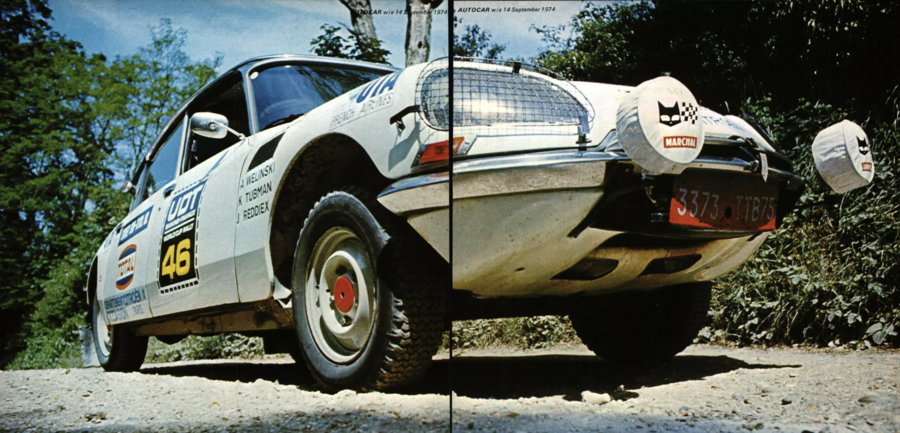
They weren't trouble-free. "They hit a small goat near Madoua and had a brush with a culvert on a corner," we reported, but ultimately they finished 28 hours ahead of the first of the three works Peugeot 504s that followed them home. Once penalties were added, the 19th and last finisher was some 18 days behind the winner.
Perhaps because it lacked the novelty of the original, or because the route was less inspiring, the 1974 event simply didn't capture the imagination of the 1970 rally. The event was announced late, the route kept changing and the ongoing fuel crisis made it hugely expensive. The manufacturers stayed away, leaving largely lower-profile privateers to take part.
Following the rally, we would describe it as "the secret adventure", while chastising the national newspapers for giving it few column inches. "We wonder whether the concept of a 10,000-mile-plus motoring marathon will survive the blow it has received this time," we wrote. "If there is to be another-and we hope that there is it may be that the tenuous link with football should be abandoned."
Time has been kinder to the World Cup Rally's legacy: the brutal event actually inspired the creation of the Dakar Rally, which continues to uphold the tradition of marathon rallies to this day. But in 1978, when the next World Cup was hosted in Argentina, the sporting drama remained firmly on the football pitch, not the stages.