Motors open up new opportunities for making a car more agile, but its potential has yet to be realised
As we enter the era of the electric driver's car, there's a lot of talk about torque vectoring - not least from me.
It's nothing new, but EVs have given it new relevance, partly because car makers are desperately scratching around for ways to make their fast but silent cars exciting and partly because electric motors open up opportunities.
Before jargon overload makes you tune out, let's remind ourselves of what it is. Just imagine a wheelchair: if you rotate the right wheel more than the left, the chair turns left, and vice versa. Tracked vehicles like tanks operate similarly.
Of course, a car is already able to steer using the front wheels, but there are limits to that. Once it reaches the limit of its grip, you can keep turning the wheels but not much will happen. That's understeer - and having the rear wheels helping along can be useful in countering it.
Then there's the fleshy bit inside, which may not be very good at actually driving the car so may benefit from some help from an unseen hand. If the computers can translate their desires (rather than their actual, less than perfect inputs) into behaviours, they might be safer and might even like the car better.
We've seen a couple of ways to accomplish all of this. Most aren't specific to EVs.
The simplest, cheapest and commonest is torque vectoring by braking. Braking an inside wheel has a similar effect to accelerating the outside wheel in a corner, with the downside that the car is wasting energy and effectively slowing itself down. It's also not unheard of for a car that relies heavily on such tech to finish a track day with its brakes on fire because the vectoring had been so busy. Done well, though, it's an easy win.
Then there are fancy differentials that use clutch packs to send power one way or another. These have featured in everything from the Mk3 Ford Focus RS to the Volkswagen Golf R to the pre-update Polestar 3. In all these cars, the effect is pretty obvious when you drive them hard. You can really feel how the rear end moves around on the power and actively tightens your cornering line. It makes the four-wheel-drive hot hatches more playful than they might otherwise have been, while the heavy electric SUV just feels much more agile than it has any right to.
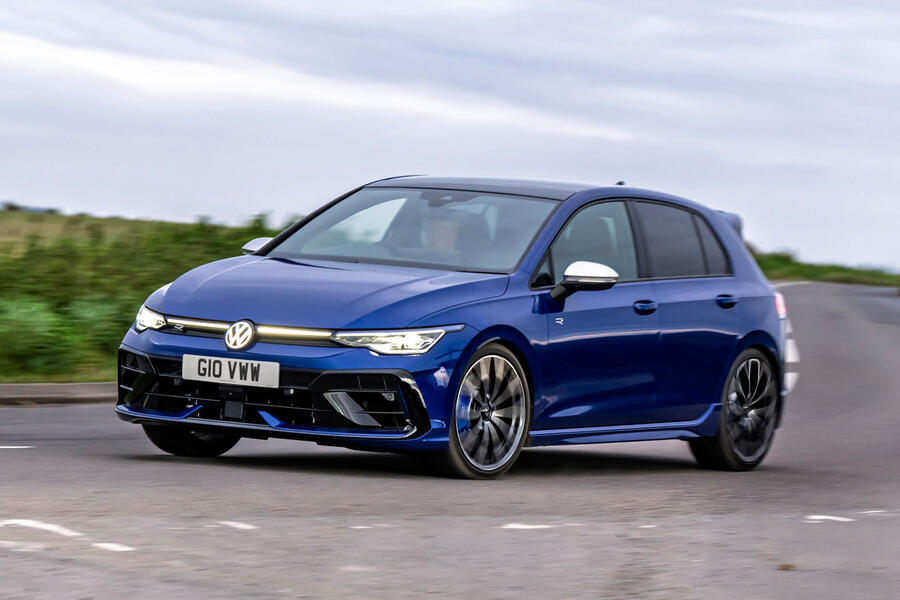
The trouble is that such systems are mechanically complex and are very hard to make and keep reliable, particularly if they have to cope with the violence of electric motors.
That's why we're seeing more and more EVs with what you might call natural torque vectoring, where the car has individual motors for the left and right wheels. This is the closest a car can get to the wheelchair concept.
There have been a couple of low-volume supercars with a motor for each wheel, such as the Mercedes SLS AMG ED and Lotus Evija. More common is to have one motor at the front and two at the back. After all, the rear axle is where the biggest opportunities for torque vectoring lie, seeing as the front wheels can already steer.
The thing is, so far I've found this a bit disappointing. I've driven the Audi SQ8 E-tron, Tesla Model S Plaid, Alpine A390 and Maserati Granturismo Folgore, and most of them felt like very fast but dynamically pretty staid four-wheel-drive cars. If anything, some of them felt a little unpredictable. The Maserati felt more playful but not out of the ordinary for a car with 751bhp.
I think the problem is twofold. The first is that such systems are so utterly reliant on software calibration for everything that there's a danger of the driving experience feeling a bit digital. The other is that with two smaller motors instead of one big motor, the most power the car can ever send to one wheel is 50%, whereas with a good electronic differential there's more flexibility.
Clearly, differentials are mature tech being applied to new drivetrain tech in EVs. Dual-motor axles are still very new and still have a way to go. I'm intrigued to see where it goes, and it's clear from speaking to chassis engineers that they revel in this stuff. At the same time, I do wonder whether it will be able to fill the hole left by interesting engines in making cars exciting day to day.