Jamie Chadwick is the first woman to drive a hypercar at Le Mans, but would have been barred just decades ago
Jamie Chadwick recently became the first woman to drive a hypercar at Le Mans, a year after making her debut in the secondary class of the fabled 24-hour race.
Many women have competed in this iconic event across the decades, yet the best female finish has stayed unsurpassed for almost a century.
"For the first time two women drivers will take part," we said in our 1930 Le Mans preview, "which will be interesting." Whether that comment was loaded is open to interpretation, but if so we were humbled by Marguerite Mareuse and Odette Siko bringing their Bugatti T40 home in seventh.
Their 1931 reprise was ended early by disqualification for a refuelling infringement, but in 1932 Siko achieved that record result: fourth overall and first in the 2-litre class in a supercharged Alfa Romeo 6C shared with grand prix star Louis 'Sabipa' Charavel.
Again, though, she was unlucky a year later: Siko was putting in "quite a good performance" in the initial hours but the next morning suffered a "sensational accident".
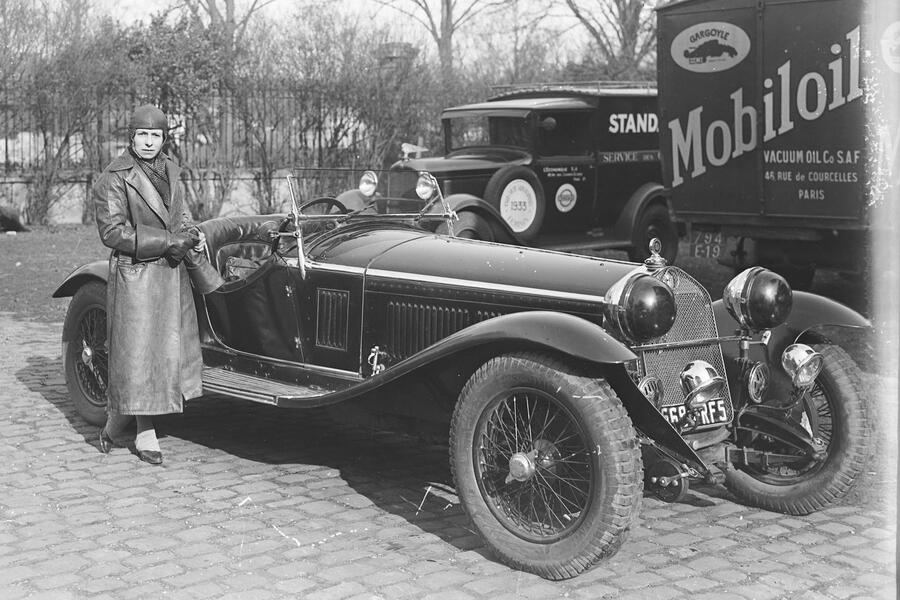
"Coming through the pinewoods towards Arnage at 75mph, the car suddenly got broadside on, crashed successively into two substantial trees, and then hit a third which was cut down six feet from the ground. They fell across the road in the track of Driscoll's Aston Martin.
"Madame Siko was thrown clear as the first tree was hit, being shot through the air and falling at the feet of a gendarme with nothing more than bruises and a complete inability to understand what had happened to her. The car, on the other hand, literally burst, the pinions coming out of the gearbox, certain parts even being found 50 yards from the main wreckage.
To add to the completeness of the crash, the chassis took fire on hitting the third tree and set fire to the brushwood and dry fir branches."
It's understandable that Siko never returned to Le Mans, but she continued to compete in speed trials and road rallies until the war.
"Femmes pilotes' were a common sight in the '30s, but there was just one when the race returned in 1949 - and not one in the late '50s or '60s.
Listed in our published 1954 race result is a Thirion, but it's unclear if this was indeed the rally driver Gilberte or her father Max, as some sources say that race officials forced a swap on account of her gender.
If this was the case, it's a mystery to us why the Automobile Club de l'Ouest (ACO) might have had such a change of attitude: just three years prior, Betty Haig and Yvonne Simon finished third in the 2-litre class, beating a male crew.
Some sources – including no less than Porsche – say the ACO banned female drivers in response to the 1956 death of Annie Bousquet at Reims.
Supposedly she was known for a hell-for-leather driving style, but Autocar absolved her of blame: "On fast sweeping bends, the worst possible arrangement to have is a ditch at the side of the road, yet this is what one finds on this stretch."
Incidentally, the sport's biggest tragedy, when at least 81 fans were killed by a flying car at Le Mans in 1955, involved only male drivers.
Whatever, the prevailing attitude is encapsulated in this unpleasant comment by The Motor magazine: "The ACO has planned a three-hour race at Le Mans for women drivers – if they can find enough women drivers competent enough to stay on the road for that long."
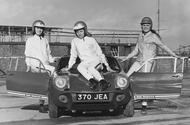
In 1967, at the height of a golden period for sports and GT racing, a trio of young Brits - Jackie Bond-Smith, Joey Cook and Jacqui Smith – set out to "crack the ban on women imposed by the organisers" with their Mini Marcos.
The ACO rejected their entry, and the RAC defended it thus: "Le Mans presents special safety problems, and a major hazard in recent years has been the speed differential between larger and smaller cars."
Smith saw it differently: "The French have a funny idea about women, haven't they?"
The supposed ban was eventually lifted in 1971, as rally driver Marie-Claude Beaumont earned the ACO's trust in an early-season three-hour race, enabling her to share a 7-litre Chevrolet Corvette in 'the big one'.
Its engine went after 14 hours, but Beaumont competed in the next five Le Mans, scoring a career-best 12th in 1973, then switching to an Alpine-Renault alongside Lella Lombardi - still the last woman to have raced (and indeed scored) in Formula 1.