M division aims for its first fully electric performance car to become the benchmark driver's EV
Synthetic gearshifts and sounds will feature on the first electric M car, an M3 based on its new Neue Klasse EV platform, BMW has said.
Due as early as the end of 2027, the quad-motor performance saloon, based on the upcoming i3, will have “a legacy to continueâ€, said Dominik Suckart, BMW’s high-voltage battery chief.Â
While BMW still “can’t talk about power outputâ€, there is recognition in Munich that it will have to work to retain the M division’s position as the maker of the most engaging driver’s cars in the segment.
Suckart described the desire “to be the driver’s dynamic benchmark with this platform†while delivering “a familiar M driving experienceâ€.
That’s the thinking behind synthetic gearshifts and noises “for an emotional M-like driveâ€, he said, akin to those used in Hyundai’s engaging Ioniq 5 N and Ioniq 6 N (Hyundai’s N division was initially headed by ex-BMW M Division boss Albert Biermann), with the latter perhaps being the electric M3’s closest rival.
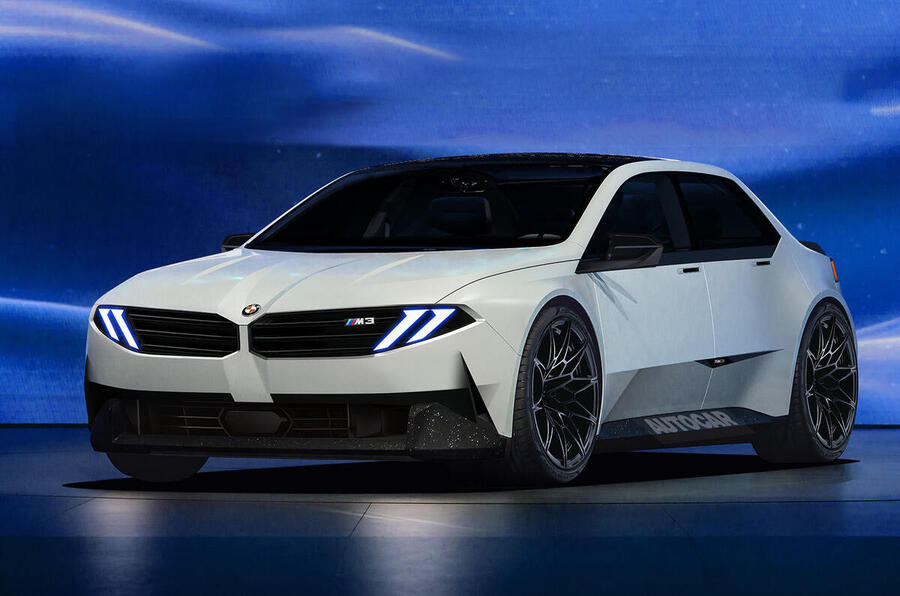
Rather than two motors like the Hyundais, the M3 EV will have four with a single control unit, inverter and reduction gearbox for each wheel. Torque vectoring will also feature.
The battery, BMW said, will be at least 100kWh in capacity and be able to offer “high sustained and peak powerâ€, with the ability to recuperate energy even at the limit of dynamics and tyres under deceleration.
The M car will have a specific software stack called M Dynamic Performance Control that will give “never-seen-before handling and traction controlâ€, according to Suckart.Â
This will give it the ability to switch from four-wheel drive to rear-wheel drive for track driving or drifting, as well as having a range-extending RWD driving mode.
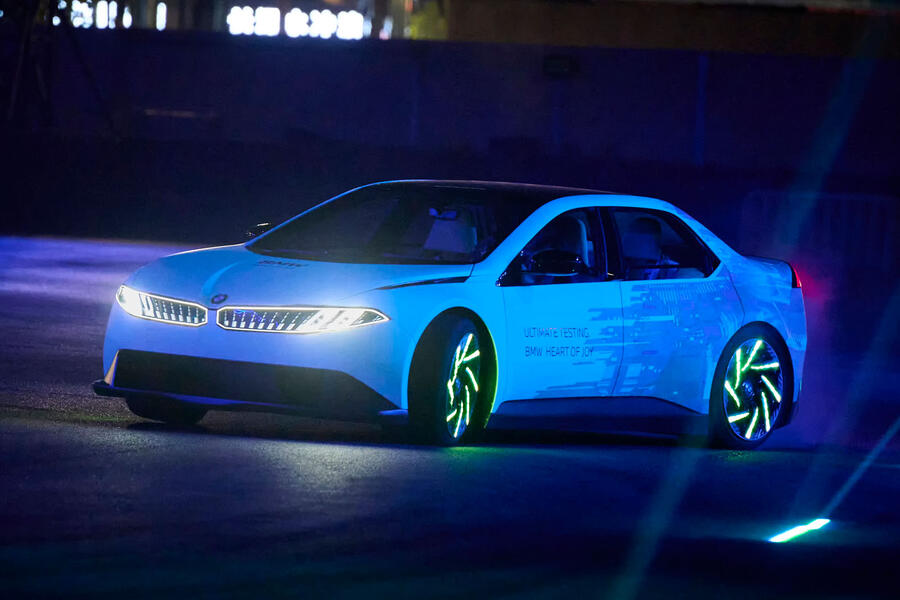
It will also use the innovative Heart of Joy high-performance control unit from the BMW Vision Driving Experience concept (pictured below). This unites all of the driving experience controls to enable faster and more intuitive reactions.
BMW also said the battery housing – an integral part of the chassis structure – will be attached to both the front and rear axles of the M3, rather than just the rear (as in the standard i3), for improved rigidity.Â
We’ve become accustomed to M cars being heavy (the current plug-in hybrid M5 weighs nearly 2.5 tonnes), but BMW said it will use natural fibres, as it does on its M4 GT4 racing car, in place of carbonfibre to try to keep the M3’s mass down wherever possible.
Natural fibres also have a 40% lower CO2 emissions equivalent than carbonfibre.
How well electric performance cars are being received by buyers is still a moot point, but “we’re excited about it, and I think you can be excited tooâ€, said Suckart.
BMW has strongly suggested that alongside the electric M3, there will also be a more traditional petrol option that uses an updated version of its venerable 'B58' straight-six engine.Â