It's amazing how much difference a throttle or steering tune can make to the driving experience
Modern car steering is a very complex dance between shafts and cogs, software, suspension geometry and flexing tyres.
But you would hope that operating it should be simple, as subconscious as breathing: turn the wheel clockwise to go right, turn it twice as much to turn twice as sharply.
Same with the accelerator pedal. Particularly with electric motors having a flat torque curve in most everyday speed ranges, you might expect that putting the pedal to the floor gives you full power and holding it at half its travel gives you half the available power.
Not always: in the Hyundai Inster that I drove a while back, three-quarters throttle equated to full power, according to the on-screen graphic. Which begs the question, what the remaining 25% of travel is for? Moral support during a particularly ambitious overtaking manoeuvre?
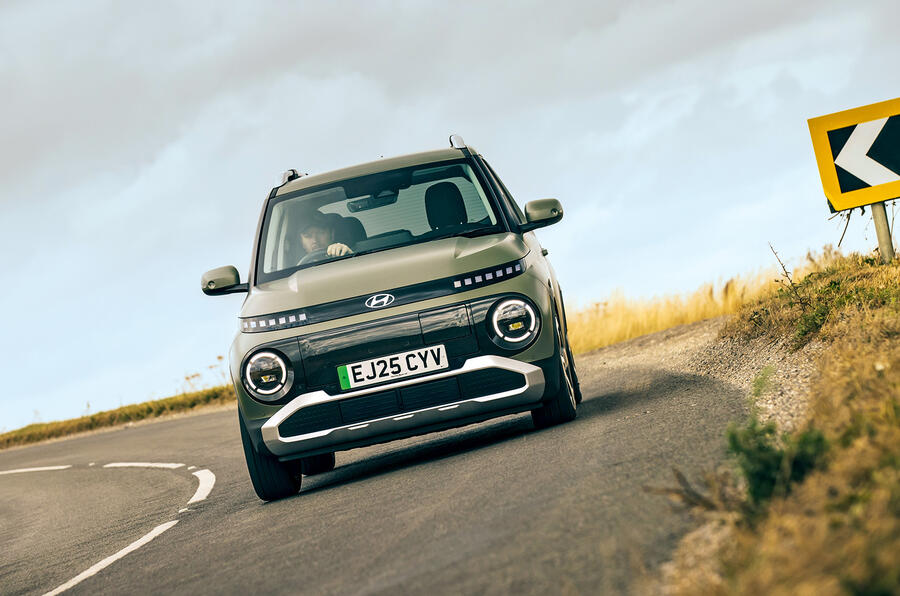
The Inster (which I found a charming thing otherwise) is far from the only offender. Sport, let alone Sport Plus mode (or similar) for the powertrain of any given car, whether electric or combustion-engined, is generally to be avoided, because it tends to map 80% of the power onto the first third of the pedal travel.
Presumably this is done to make the car feel faster than it is initially, at least. Given how many manufacturers are guilty of such tricks, there must be some research somewhere that says customers love it.
Heck, even the Ferrari 12Cilindri gets jumpier as you dial up the spicier modes. Wanting a rear-driven, 819bhp, 0-62-mph-in-2.9 sec car to feel faster than it is seems psychopathic to me, but there we go.
I try to drive smoothly even when I'm alone in the car. It's so refreshing to drive an old BMW M car or a current Ford Mustang and find a loooong-travel accelerator that is 100% functional. I've never driven a TVR, but I'm told they effectively used long throttle pedals as DIY traction control, which may be taking things in a slightly sinister direction.
Where accelerator linearity is sometimes a setting in a menu that the driver can adjust, steering tends to be baked in, and it's remarkable how many ordinary cars have excessively darty steering off-centre. Renaults are particularly bad for this. The 5, Scenic and Megane all have steering that isn't unusually quick overall 2.5 turns or so between locks but makes flowing smoothly down a B-road needlessly difficult.
I can see the purpose of variable-ratio steering that gets quicker as you turn the wheel, because this makes it calm around the dead-ahead but requires less wheel-twirling when parking. But what's happening on Renaults, and indeed quite a few Audis and BMWs, is surely the opposite of how it should be done.
There are cars that show there's no need for this superficial hyperactivity. The new Honda Prelude's steering is just two turns lock to lock, yet it's progressive and full of feel - some of the best steering I've experienced in a mainstream new car.
Presumably all of this is done so that cars instantly feel 'sporty' to prospective customers taking a test drive around a suburban block. The ludicrous power outputs of some EVs fit into this picture: you try it once and scare yourself silly, then just use it for bragging rights.
If this is what's needed to sell cars today, I won't say it's wrong. But I am convinced that there's a better way. When you drive a car with carefully tuned controls (the Mercedes-Benz CLA EQ, Skoda Superb diesel and Volvo EX90 spring to mind), it just feels right; it feels relaxing. It can be hard to put your finger on why, but the effect is unmistakable.
Can't we all use a bit of calm in our lives? It must be possible to make that into just as much of a selling point as 0-62mph in 3.0sec.