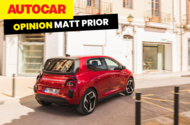
Has the threat of cheap Chinese EVs finally forced Europe to build lighter, better-driving cars?
There are just 700 parts in the new Renault Twingo electric city car, according to Renault. Which sounds like not a lot. I don't quite understand precisely how they define a part.
I mean, if you were to separate every strand of wire in a cable, every element of every clip and connector, every individual battery cell, surely it would be more? I don't know the minutiae. And actually it doesn't matter, so long as they're using the same metric across all their cars. Which they do, because they want to track it and know themselves, because this sort of thing is the key to making the frog-faced new Twingo available for less than £20,000.
The Renault 5, by comparison, has more than 1200 parts in it, so it is quite a reduction from there - and it's a bigger cut again from something like the Clio, which typically has more like 2200-2500 parts.
Many of those are in the engine, which explains why an EV like the 5 can have fewer bits than a combustion car like the Clio. But to shave another 40% of the parts out of the 5 strikes me as pretty remarkable.
The reduction and also the extremely short timescale in which Renault has developed the Twingo - only "100 weeks between kick-off and production" - is down to its new Advanced China Development Centre in Shanghai, which it opened in 2024. The Twingo is its first car to use this way of finding suppliers.
The short timescale is apparently allowed by some extremely tight deadlines offered by Chinese suppliers. Renault brand CEO Fabrice Cambolive told me recently that while some European suppliers can take a week or two to confirm pricing and supply details, Chinese suppliers will confirm within a day.
But the parts reduction is down to more than just that. It's also down to a ruthlessness in the design phase to cut components wherever possible - without, so the plan goes, letting the customer know they've done it.
Here's an example: the Twingo has a funky-looking hazard warning button, which is backlit in the dark. It looks great. But it caused tremendous arguments, because although it in itself costs only a few pence, by the time that's multiplied by several hundred thousand units a year and then by the decade for which it might stay in production, this little part presents a rather large bill.
The designers and marketers, who wanted it, won that one. But there will have been others they lost, and other arguments that other designers or engineers won and lost, and the result is a car that, even though it's electric, weighs 1200kg. They think that's 250kg less than the 5.
It has a smaller battery, granted (we will see how its winter range fares), but I'm inclined to be quite buoyed by the weight reduction. We know that EVs are heavy. We know that the Chinese car industry is arriving in Europe selling cars at prices that European car makers are finding hard to match.
If the competition is making European car makers find ways to cut parts and weight, and if they can do it without us feeling the cars are cheaper, we'll get more efficient, lighter vehicles that hopefully will be better to drive. If so, I'm for it.