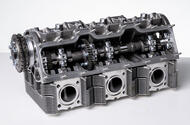
Back in 2023 Swindon Powertrain announced its four-valve cylinder head kits to fit the Porsche 911 964 and 993 M64 engine.
The company reached a milestone recently when it supplied its 100th kit, which is designed for use by specialist engine builders and requires the rest of the engine to be modified to withstand the extra power and revs. The standard M64 engine has two valves per cylinder, but the new heads open up the engine's breathing to raise a 993's redline from 6900rpm to as high as 12,000rpm.
Gloucester-based modification and restoration specialist Thornley Kelham is using the kit on its limited-edition 911 European RS, of which only 15 will be built with a choice of two engines. The capacity of the first is the standard 3.6-litre, making more than 380bhp and up to 290lb ft and revving to 10,000rpm. The second is a 4.0-litre producing 425bhp and 325lb ft with a slightly lower rev limit of 9000rpm.
Four-valve-per-cylinder engines date back to the early 20th century, with the 1910 Benz 21/80hp being one of the earliest. Rolls-Royce Merlin aero engines had them in WW2, Ford caused a stir with the rally homologation Escort RS 1600's 16-valve BDA engine in 1970, and the Triumph Dolomite Sprint appeared in 1973, with its 2.0-litre four-valve unit recognised as one of the first mass-produced, four-cylinder multi-valve engines.
So while four-valve heads aren't new, Porsche didn't use them for its air-cooled engines (apart from watercooled four-valve heads on the otherwise air-cooled 935 racer in the 1970s and the 959 in the 1980s).
Multi-valve heads are a way of drawing more air into a cylinder and burning proportionately more fuel, in turn releasing more energy. Four-stroke engines with two valves per cylinder have a single inlet valve and smaller exhaust valve per cylinder. Valves (very) roughly resemble a plate on a stick: as the valve is opened by the camshaft, it lifts off its seat in the cylinder head to reveal - to open - the inlet port. As it does so, the circumference of the valve describes a sleeve or tube known as the 'curtain area', and on the inlet side the size of this area has a lot to do with how much air and fuel can be drawn into the cylinder.
The combined curtain area of two inlet valves is greater than one (unless a single valve were opened an unfeasible amount), allowing more fuel/air mix into the engine. Peak flow into the cylinder of a 993 engine is thus increased by 40% over the twovalve original. Smaller, lighter valves and springs reduce inertia at high revs, too. Swindon's kit adds to this key benefit with valves made from superlightweight titanium, and correspondingly lighter springs overcome another critical barrier to safely achieving high revs.
Â