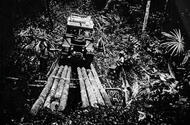
Beyond the end of the road in Panama looms one of the world's least hospitable environments
"In a few years, you yourself may be driving through the Darién at high speed on a smooth and skilfully aligned surface. Your wife may lean out of the car window and say: What a lovely jungle."
So wrote Richard Bevir in Autocar in 1961, having himself crossed the wilderness separating North and South America, in the expectation that the Pan-American Highway project would soon be completed.
Yet even today the mountainous jungle of the Darién Gap is an image frequently invoked when someone wishes to exaggerate the abilities of the very toughest off-road vehicles.
Bevir, a former SAS soldier, was accompanied by Aussie outback mechanic Terence Whitfield in his 88in Series 2 Land Rover, and by Panamanian anthropologists Amado and Reina Araůz in a Jeep owned by a committee existing to research how the Pan-American Highway could be completed.
After 13 months of planning, in December 1959 they assembled at the end of the road, in Panama, beyond which loomed one of the world's least hospitable environments, populated only by isolated tribes.
"It was 134 days later when the expedition emerged into the sunshine of Colombia," Bevir wrote in Autocar. "The intercontinental link had at last been forged. But we'd had to blaze 310 miles of twisting trail, build 125 palm log bridges, ford 180 rivers and creeks, build three rafts, combat malaria, dysentery and jungle exhaustion, and treat festering sores and raw feet. We became reduced to a diet of rice, bananas, monkey and lizard. In the rainy season we stayed wet for six weeks, and at night we lay in our hammocks with our sodden boots on, while mosquitoes whined in our ears and the incessant downpour of tropical storms prevented much-needed sleep."
Temperatures often exceeded 43deg C in open grassland areas, and although it fell to 34 beneath the dense rainforest canopy, the humidity was then nearly 100%.
It was a hugely impressive feat - yet not as impressive as that of the American cohort who replicated it shortly after, because they drove unmodified, RWD saloons (albeit with 4WD support trucks in tow) and they were young newspaper reporters and dealership staff, not hardened outdoorsmen. Quite the way to promote an affordable new saloon to picket-fence Americans.
It almost beggars belief, but they were helped by the rear-engined, rear-driven layout of the all-new Chevrolet Corvair putting a great deal of the weight over the rear axle and thus generating excellent initial traction-and lots of winching from the supporting Suburbans. Their 244-mile adventure took 107 days – and, best of all, they filmed it in colour, resulting in a fascinating 17-minute film, its narration laden with that '60s optimism, which you can now watch for free.
The Darién Gap wouldn't successfully be traversed again until 1972, when British Leyland sent two of its new Range Rovers on a mission from Alaska all the way down to Tierra del Fuego, undertaken by a large British Army contingent commanded by John Blashford-Snell and Gavin Thompson. Before them ran 'Pathfinder', a locally purchased old Series Land Rover, which "motored almost non-stop, giving no trouble whatsoever".
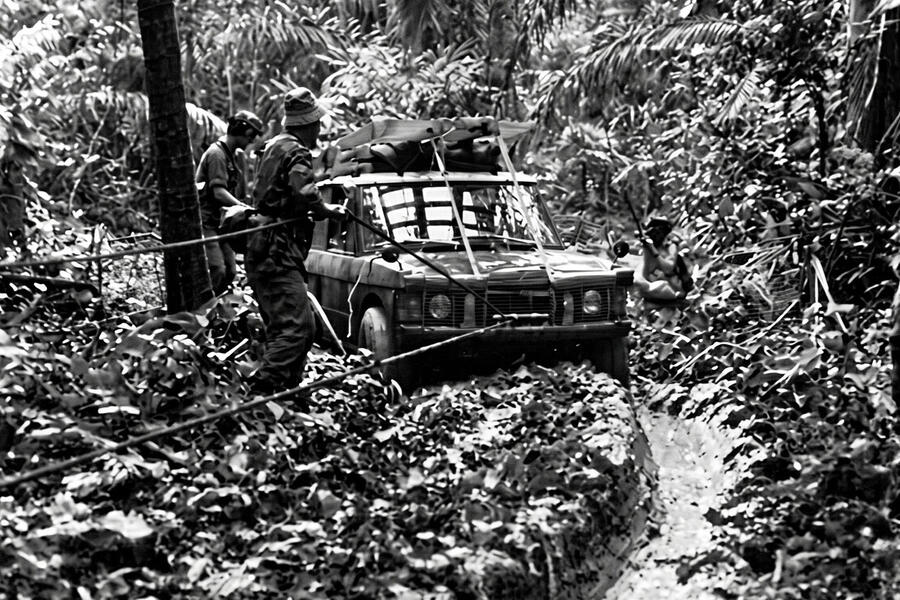
"What with the ladders, raft, and all the gear of the Royal Engineers accompanying them, each car was carrying a good deal more weight in the early stages, and a lot of that was on the roof," we reported. "Very nearly all of it went on the rear axle. You can lock the centre differential but not the axle diffs; inevitably a lot of wheelspin was indulged in. "Another factor making life difficult for the transmission was the use of swamp tyres - 'Bog trotters', Rover calls them - which are much bigger and therefore heavier than standard tyres."
Environmental and cultural concerns ultimately prevented the completion of the Pan-American Highway, and now the Darién Gap is even more dangerous, used as a hideout by criminal groups and a major route for human smuggling. So it's possible that 1980s crossings by Jeep CJs will forever be the last.
The honour for the first crossing has changed, however: a Brazilian historian recently repopularised the tale of three young men who left Rio in Ford Model Ts in 1928 and arrived in New York a full decade later. Now that's a book that needs translating.