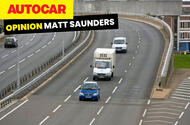
Middle lane hoggers, speeders, constantly jostling lorries - the policing opportunities are endless
Our correspondent John Evans updated us recently on the UK government's plan to use AI-powered road safety cameras and the wider application of penalty points to enforce better compliance on our roads for things like seatbelt wearing, vehicle tax and insurance.
I'm uneasy with the idea of even more surveillance, yet I find myself in favour. You thought road testers were all libertarian speed freaks, right? Don't we deliberately go where the cameras aren't and where traffic is light to get to grips with the latest performance cars?
Of course we do. But those roads where we know we can do our jobs easily are very valuable to us. Experience teaches us not to treat them like race tracks, to advertise their whereabouts too loudly or raise the enmity of their local communities while we're on them. Before we know it we will be back, after all.
In the end, we all just want better driving and roads that work, don't we? Those of us who spend more time on them than the average bear, for whatever reason, all the more so.
Before going any further, an admission: I was recently 'awarded' another three points. It was a fair cop: I was doing 59mph on an A-road local to my home that was, until a few years ago, under the national speed limit. I probably needed a punitive reminder. And, sure enough, it has made me more aware of how fast I'm going and whether I've disabled the speed warning buzzer of the car I'm driving (as I've got into the apparently costly habit of doing).
It's easy to see how preoccupied with speed the UK's system of camera-based enforcement is, however. If the government is seriously considering extending its reach, shouldn't it be part of a bigger rethink about speed limits, motorway regulations and lane discipline? And if the current speed-centred system hasn't significantly reduced mortality for the past 15 years, isn't it time it focused its gaze elsewhere?
The UK has long had different speed limits and lane permissions for lorries, bigger vans and heavier pick-up trucks than for cars, for example. But these pretty plainly aren't enforced by our current motorway cameras - which, it seems to me, is really feeding the biggest problem we have at the moment: poor lane discipline.
We've been talking about higher motorway speed limits on and off for decades. But what would be the point, given the likelihood of a Ford Transit or Mercedes Sprinter blocking the outside lane?
So, come the revolution, I would start by restricting lorries and coaches to lane one on both two- and three-lane dual carriageways, or lanes one and two where there's a fourth lane. That way we won't get those interminable, 56mph motorway truck races that bottle everything up.
Next, I would limit smaller commercial vehicles (vans, minibuses and pick-ups of all sizes) to lanes one and two but extend the 60mph dual-carriageway limit that applies to some of them in some places to 70mph for all of them.
And finally, I would let cars and motorbikes travel at up to 80mph and have exclusive use of lane three, as well as shared access to lanes one and two, but find dependable ways to penalise their drivers for not 'keeping left' when they patently could.
I'm not sure that AI cameras could fairly or safely police a fixed penalty for middle-lane hogging, so that would have to be left to the patrol bobbies.
Otherwise, and as suggested, it wouldn't be a huge change to the status quo, would it? We might have to introduce a minimum following distance limit for lorries and coaches, so as to leave space for everyone else to make their motorway exit, but that could be enforced by camera quite easily.
Wouldn't traffic ultimately flow better that way? Wouldn't we all get to where we're going that bit easier? Surely the AI cameras that the government is talking about here are capable of helping to clear up the mess made of our motorways by their various predecessors?
If they could, they might not be such an unwelcome addition.