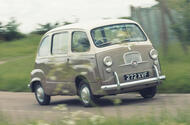
The 600 Multipla showed just what was possible in a small car, but was it actually the first MPV?
Manufacturers often make dubious claims in their marketing. For instance, in finally publishing UK pricing for the Topolino microcar, Fiat called it "a fresh approach to urban mobility", despite it being nothing more than a restyled Citroën from six years ago.
The Italians were, however, justified in claiming to have made the "original people mover" when revealing the four-seat Multiplina. Well, at least if you add the prefix 'miniature', given buses and VW Type 2s existed long before 1956.
We were really enthused by this innovative "surprise package from Turin", reporting: "The little multi-purpose vehicle [MPV] is based on the 600 and named the Multipla. Its appearance has received a mixed reception, but a full six-seater on a [2000mm] wheelbase, the same as a standard saloon, cannot be made to look sleek and low. It is trim and functional without undue austerity, and as an engineering feat is quite breathtaking."
We felt it was "the nearest approach yet in the world of motoring to putting a quart into a pint pot", as "scarcely a cubic inch of space is wasted, and it carries up to six people in very reasonable comfort, or an equivalent quantity of luggage or goods".
Our road testers marvelled at its unique construction as it landed in Britain, priced at £799 (£17k today) a year later. "It may be described as a small station wagon in which, because the engine is at the rear, the loading doors have been placed at the sides. On the other hand, in the absence of a power unit in the nose, the front seats can be located over the front wheels, leaving the maximum space behind them for seating or goods as desired. The floor area is large, low and uninterrupted by tunnels or frame members, and is a part of the platform frame."
Just make sure you don't crash...
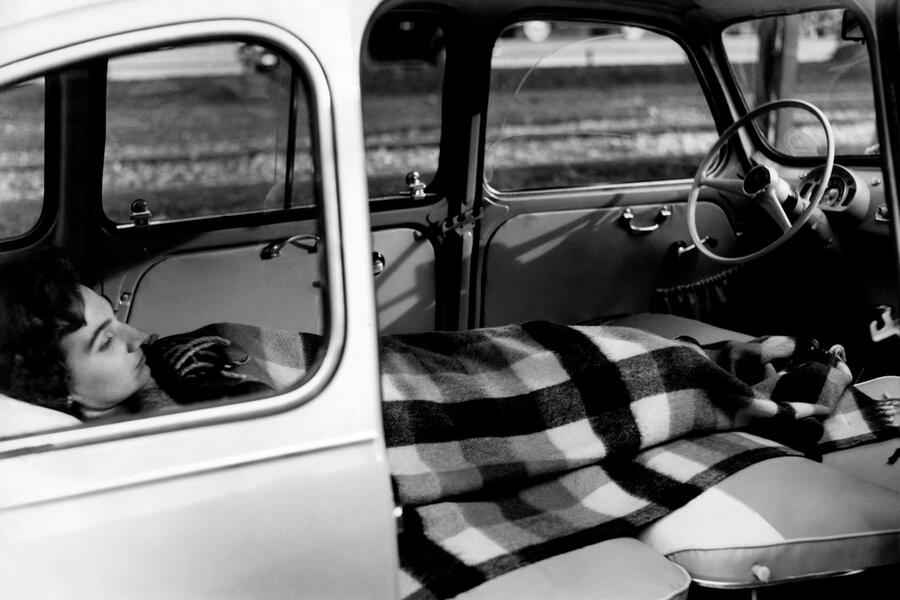
One early adopter, M Ogle, sent us a love letter: "I've just returned from a fortnight in France. My wife and I slept in the car on air mattresses, and even ate in it on cold or rainy days, using a folding table which can be set up inside. Passers-by were quite astonished, as well they might be: I doubt if there is another car in the world so adaptable.
"Performance is very adequate: the car holds 45-50mph indefinitely. The overall fuel consumption has been a shade better than 47mpg on average, covering all kinds of load from two up to five adults and two children (each with a proper seat and no sardine-in-tin feeling). Visibility is wonderful because of windows all round. It is easy for elderly people to get in and out. The four seats at the rear fold flat into the floor in a matter of seconds. The rear engine could not be easier to get at, nor the spare wheel housed in front of the passenger - it does not get in the way of even a tall person's knees."
No wonder almost a quarter of a million Multiplas found homes over the next decade.
Was it really the first car of its type, though? Certainly it was the first to be put into production, but we had seen similar prototypes earlier.
We ignored it in our 1939 Berlin motor show report, rightly focusing on the seminal Volkswagen instead, but there are certainly hints of MPV in Karl Schlör's 'egg' or 'woodlouse' car, which seated seven within an ultra-streamlined, 4.3m-long body atop Mercedes' 170H saloon chassis.
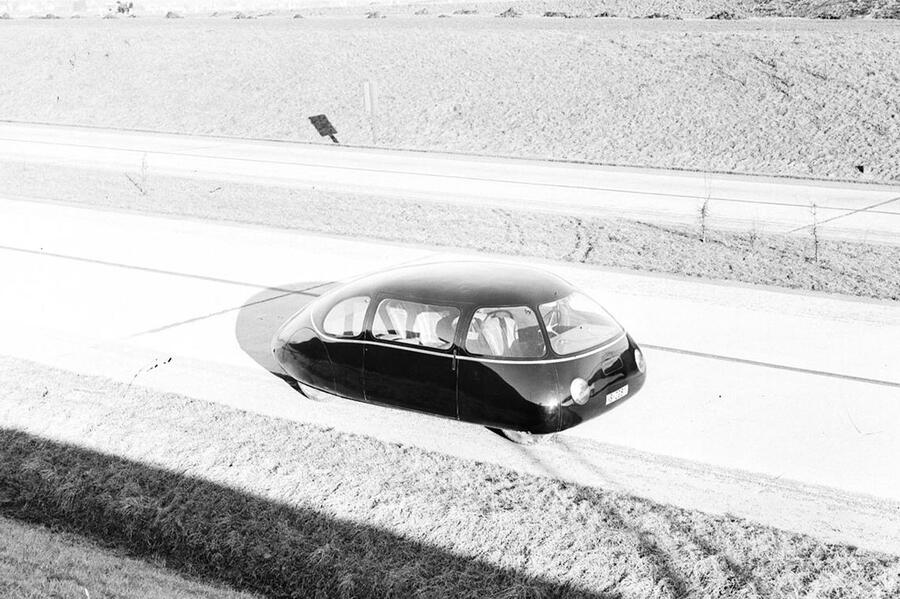
Then, in late 1945, we described one created by American aerospace engineer William Stout, under the amusing title: "This car may seem strange, but it has its advantages".
"The Stout Scarab has no chassis proper," we marvelled. "The body is formed structurally, as an aeroplane fuselage. The seven-passenger car is rigid and light, at less than [1360kg]. Seats can be arranged at will and even converted into Davenport-type couches. There is a table which can be set up when desired for bridge or luncheon, and the entire interior is suggestive of a small yacht rather than of a car, yet the overall length is no greater than that of a medium-size car of ordinary design."
It's interesting to note that Stout's mantra was 'Simplificate - and add more lightness', several years before virtually the same was adopted by Lotus founder Colin Chapman.
Our prototype drive revealed "the steering is light and it flits about and manoeuvres in small compass. With its Ford V8 it is fast and comfortable, too. But whether it will be made in quantity no one can say at present."
It wasn't, because people thought it looked weird and it cost a grand.