Our road test editor dives into the technical make-up of the new VW Buggy-based EV
Britain has a new lightweight sports car, the Mika Meon, and it has given me new hope about the potential of electrification within this particular micro-corner of the market.
Robin Hall and his team opened up the Mika office and workshop premises when I visited to test the Meon recently. Hall is a design engineer by trade. His company, Hall Engineering and Design, has been built on computer-aided design, which he does for all manner of clients.
He has a 3D printer in his office kitchen for producing prototype parts and a 3D scanner for the reverse engineering of existing ones. So there’s nothing antiquated, backwards or even particularly ordinary about this clean-sheet electric beach buggy design.Â
“Typically, the makers of niche sports cars like ours rely on a lot of parts bin components,†Hall told me.
“We’ve taken some off the shelf for the Meon, where that makes sense [ball joints, bushings and minor cabin components, for example]. But where we can get an advantage by designing our own parts – making them ourselves too, often – we will. That way, we needn’t adapt one part in order to squeeze in another; we get exactly what we want.â€
The Meon’s brake calipers, for instance, are of Hall’s own design, machined from billet on site. Its front hub carriers are likewise proprietary, giving Hall ultimate control of attachment points and front-axle geometry (he previously designed the front hubs for the R50-generation Mini hatchback).
Hall is the kind of person who takes Henry Royce’s old maxim of “take the best that exists and make it better; if it does not exist, design it†rather seriously.
Mika’s chief technician, Dave Watt, showed me how the Meon’s chassis and axles come together. Lengths of tube- and box-section steel come in one door, finished chassis eventually go out of another and a lot of cutting, bending, bolting and welding of metal – much of it done by hand – goes on in between.
“Wishbones are the fiddliest,†said Watt, having first shown me how he cuts steel to size on a lubricated band saw (a device about the size of a coffee table, which would make a real mess of the place if it went wrong) and then forms it using a tube bender (a big ratcheted lever bolted to the floor that bends tubes around purpose-made blanks of particular radii).
“I can weld a whole chassis in less time than it takes to make a full set of wishbones.â€
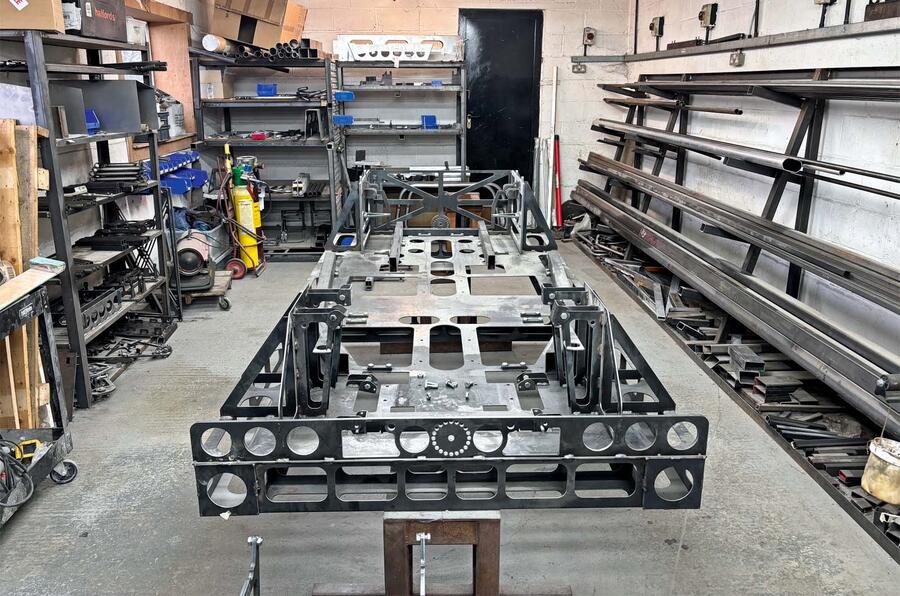
The welding is fascinating. Most of it happens on a purpose-made chassis jig (designed by Hall) that takes up a good chunk of the workshop floor itself.
It looks like something from a 1950s racing Ferrari, complete with cutouts for easy access to joins and rotisserie-style mountings so that it can be rotated around its middle.
This is production tooling in the classic sense, although it still produces build quality accurate to within a couple of millimetres across the car’s total length.
Watt slots each perfectly formed chassis member into it, then sets about joining them with spot welds first (“so the metal doesn’t warp and move as it coolsâ€) and the bigger seam welds after.
When he’s finished, the Meon is four times more torsionally rigid than a Lotus Seven-style sports car typically is – and complete with batteries, seats, wheels and trim, it still weighs less than 700kg. Amazing.
As long as Britain’s cottage industry car business is in the hands of people like Hall and Watt, you can believe that they’re very capable and safe ones and they can still do remarkable things.