
Recent Updates
02/22/2026 12:00 PM
High and mighty: We drive the £150,000 portal-axle Ineos
02/22/2026 12:00 PM
I spent my childhood car spotting - I wouldn't have it any other way
02/22/2026 12:00 AM
The undesirable Jags are turning into classics
02/21/2026 12:00 PM
We invented the Dacia Sandman - and the internet fell for it
02/21/2026 12:00 PM
The VW Scirocco at 18: Distinctive, sharp and still relevant today
02/21/2026 12:00 AM
Five ways the Alpine A290 marks the return of the hot hatch
02/20/2026 12:00 PM
Faster, classier and 50mpg: Jaecoo 7 PHEV smashes my petrol variant
02/20/2026 12:00 PM
The campaign to turn Britain's railways into roads
02/20/2026 12:00 AM
630bhp, 2370kg: Audi RS5 revealed as brand's first hot PHEV
02/20/2026 12:00 AM
Automated expensing is coming for EVs
EV, Hybrid, Hydrogen, Solar & more 21st century mobility!
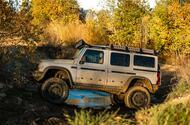 Letech has turned the already capable Ineos Grenadier into a raised, formidable off-roader
I'd wondered why there were two exceedingly buff French policemen tailing a group of reporters around during a tour of the Ineos factory the last time I was there.
Radios, pistols, what looked like smoke grenades in belts. Very tight shirts, desert boots. A little alarming. And very large muscles. I hadn't realised that security needed to be so tight.
Were a group of weedy journalists so likely to bomb the final trim and assembly line? Obviously not, it was patiently explained to me.
The police, from France's RAID (Recherche, Assistance, Intervention, Dissuasion) rapid response anti-terrorism squad had brought along their fully kitted Grenadier to put it on display, and then opted to join the tour.
The radios (and guns) were simply ready in case they got the worst kind of call that necessitated their exit at speed.
These are the kinds of people - plus German firefighters here, utility companies there - who are putting the Grenadier into proper work, I was told.
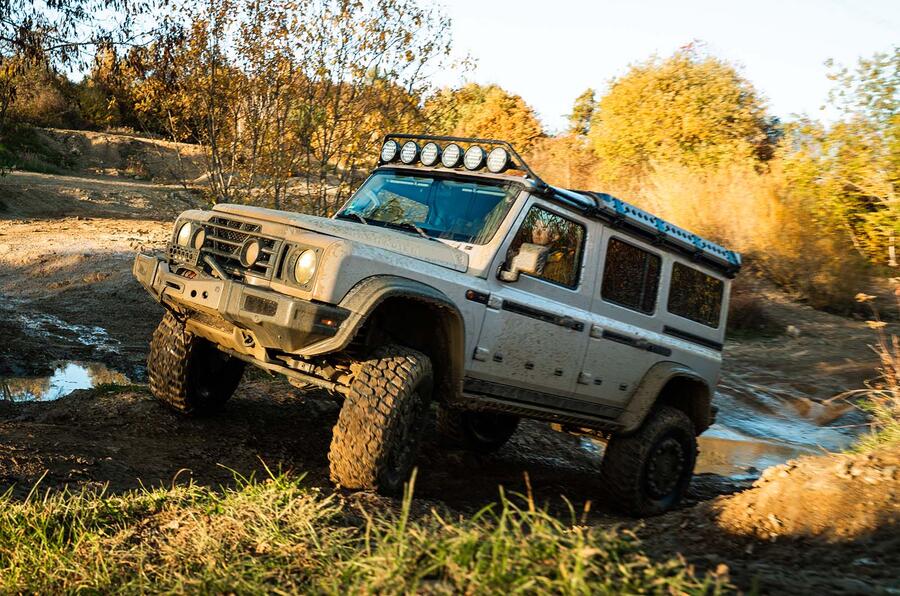
And for those who find the standard car too puny, there's now even a version with portal axles. Gosh.
Which is why I find myself in a quarry an hour from Munich looking up and I am looking very much up at an Ineos Grenadier that has been lifted and widened to the extent that a standard car, which I always thought appeared quite beefy in normal trim, looks like me next to a RAID copper.
The Grenadier Trialmaster X Letech has been tweaked, lifted and widened by German off-road tuner Letech, which also puts portal axles on Mercedes G-Classes.
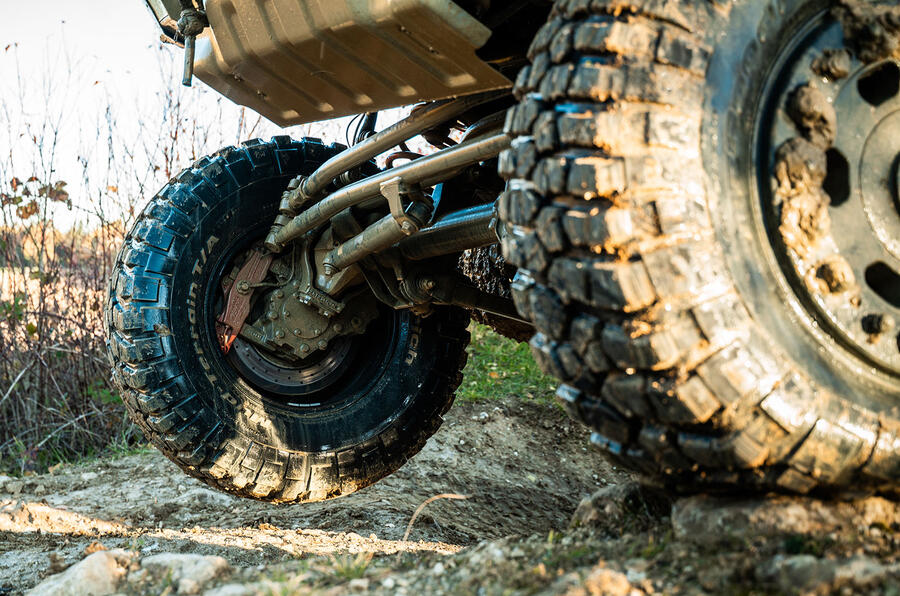
For the uninitiated, the portal axle is a mechanism (used by Unimogs since their origin and quite a lot of agricultural vehicles too) to increase their ground clearance.
If you fit a car that has a solid/live axle with a straight suspension lift, that will raise the body but it won't do anything about the axle, which sits across the middle of the wheels, leaving the differential and driveshafts dangling just as before.
Imagine, though, if you could lift the car and axles northwards, but still leave the wheels on the ground. You'd create much ground clearance.
Portals are the mechanisms that join the ends of the axle to the wheel hub, allowing this to happen. It's effectively an in-hub gearset, and because its gears are all nestled just behind the wheel itself, clearance in the middle of the car is much improved, which is particularly helpful in muddy ruts.
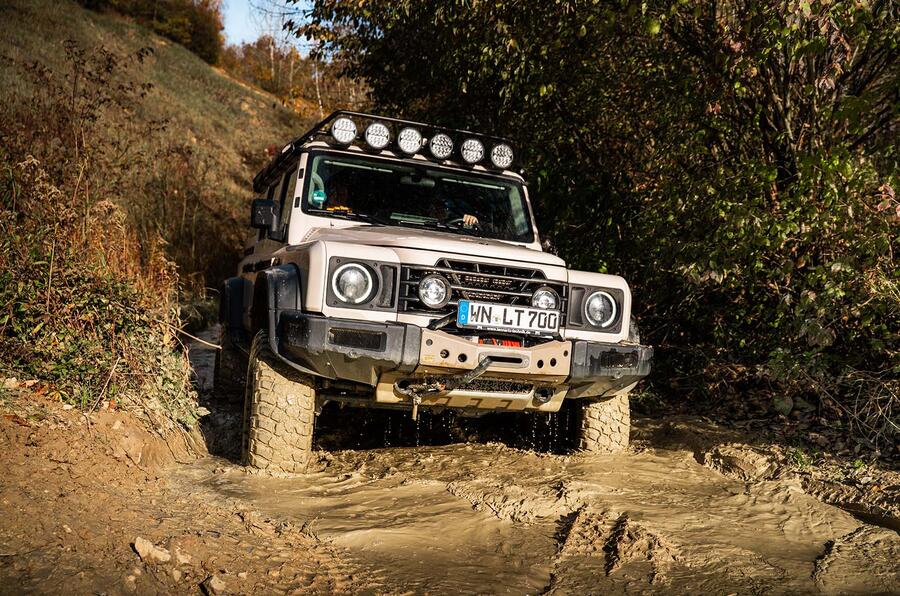
Unimogs even have offset differentials thanks to unequal-length driveshafts, so that the diff is pushed to one side and is even less likely to ground. But the Grenadier's application is rather more straightforward.
Andreas Lennartz is the owner of Letech. "We are not allowed to touch the body," he says, explaining that the modifications Letech has made to the car are all simply bolt-on hardware.
"We've put on all the things we know," he says, "to make a top-specification car with a maximum capacity in off-roading."
The upshot is a lift of 186mm of all components bar the wheels and parts directly attached to them. The gubbins adds 150mm to the axle width too, making for a 210mm-wider car with the new wheels and tyres 18in items fitted with 37in BF Goodrich KM3 Mud Terrain tyres.
But importantly, though the tyres have a far larger outer diameter, the portal axles incorporate reduction gearing so that the car's overall gear ratios remain as standard.
Once, other than an iffy speedometer, it wouldn't have mattered if they weren't, but today it does, because if the gearing changed, all of the electronics would have to be recalibrated too, which would mean them then having to be re-homologated, which would be terrifically expensive.
Here, all of the dynamics systems stay as they were: the ABS, the stability and traction control, hill descent control, the works. The wheel speed sensors read from the right cog, and everything stays hunky-dory as per factory specification.
The suspension, for 90% of owners who need more ground clearance, can stay the same too, though it doesn't have to. Ineos already fits seven different kinds of spring and damper depending on engine variant, body variant, or even if the car is specced with an on-board winch, and how the customer wants to use the vehicle.
A similar deal applies now. If you want to pootle around town thinking you look hard, you could leave well alone. If you're the German off-road fire and rescue service and you plan to cross moorland with several hundred litres of water and specialist lifting, cutting and rescue kit in the back, you'll be wanting something beefier.
You can spec KW shocks with adjustable compression and rebound, coil springs that have air springs within them, and dampers that even have external oil coolers.
But "the standard suspension is really not bad", says Hans-Peter Pessler, Ineos Automotive's chief operating officer. "For 90% of people, standard is fine. But you can really use these in heavy-duty conditions."
Whatever you do, the increase in off-road performance is marked. "We have a really nice capability and ramp angle," says Lennartz. "It's all about ground clearance."
From a standard Grenadier, the approach angle has increased from 35.5deg to 45.5deg, breakover angle from 28.2deg to 43deg and departure angle from 36.1deg to 46deg.
Ground clearance is up from 286mm to 450mm and wade depth has increased from 800mm to 1050mm. But there's more to it than that.
With the bigger wheels "you have more tyre on the ground", says Lennartz, explaining that the contact patch is inherently bigger.
But if you spec a tyre inflation system with it too, as serious utility users do so you can inflate or deflate without leaving the cab, you can easily increase the footprint again: going from 2.5 bar to 0.8 bar increases the contact patch threefold. "We say 4x4, but then you have a 12x12," says Lennartz.
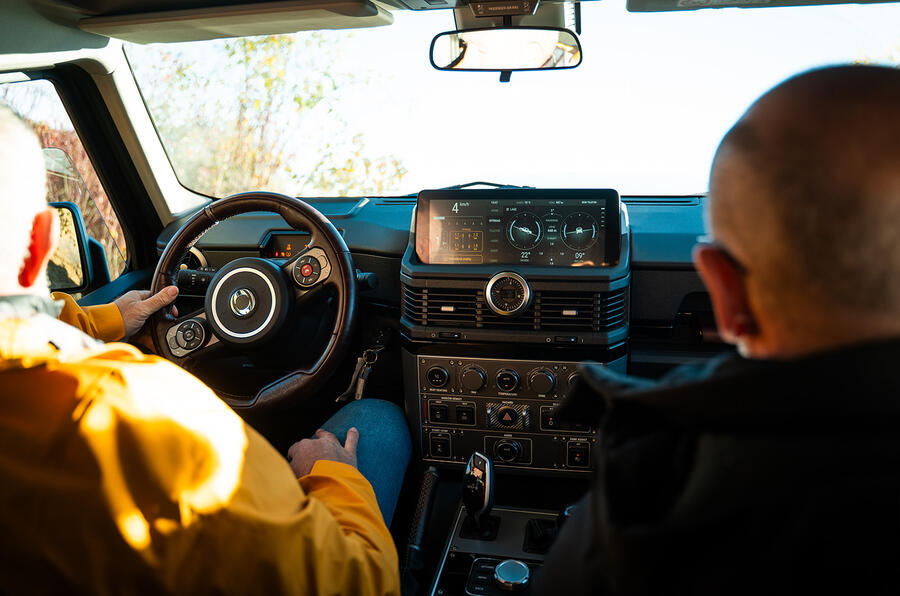
The standard Grenadier is exceptional off-road. It's one of the heavier cars in its class owing to its separate chassis so muddy inclines, where gravity is its enemy, are perhaps where it struggles most.
The new tyres and the fact that it won't ground take it to another level. Yes, it is a different day at a different place on a different surface from the last time I drove a Grenadier off-road, and even in the same location it's difficult to ensure that back-to-back tests are consistent, but it takes just one muddy incline to convince me that this is much more capable than a factory-spec equivalent.
It's hard to put a number on how much more able it is: 20%, 30%. The short of it is that if it won't go somewhere before but will afterwards, it's 100% more useful.
And depending on your need, you might have to have it, even at €170,000 (£149,400 plus local taxes, for the completed shebang, not just the upgrades).
With off-the-shelf aftermarket components, one can make Jeep Wranglers do amazing things too, but what's remarkable here is that, as Lennartz says, it "handles on the road quite normally".
I take a Quartermaster pick-up out onto local roads and find that, largely, that's true. The additional width can be a little daunting and the tyres have done nothing for steering accuracy, which wasn't amazing in the first instance. But "big wheels also mean comfort", says Lennartz and the portal-equipped car does ride nicely.
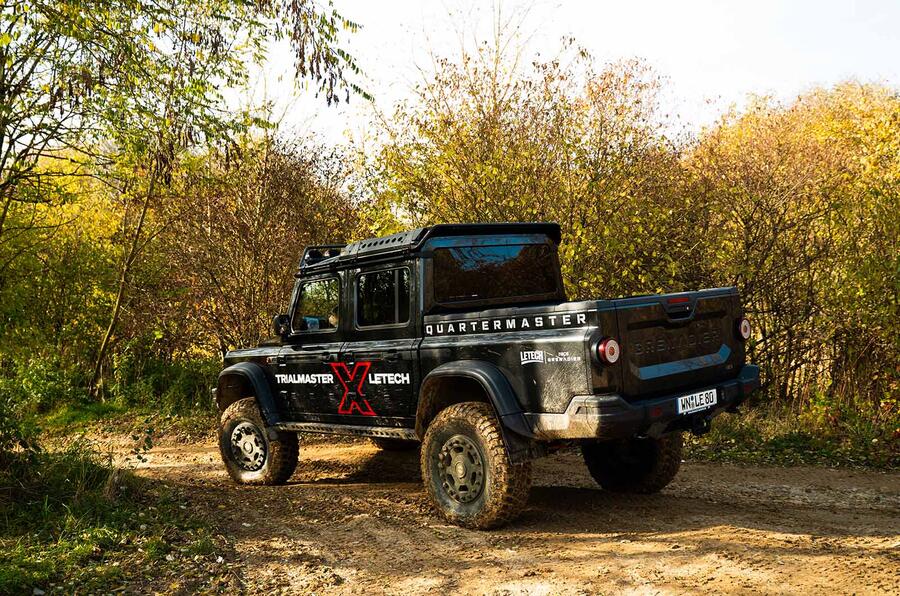
Besides, it's still a slabsided 4x4 with very big mirrors and obvious extremities, which helps to thread it through tight roads. You could - unlike whatever rivals it - drive it daily quite happily.Â
What does rival it? Not too much obvious.
It's a more serious and versatile utility car than monocoque 4x4s, you can spec a chassis cab as with some pick-ups, it remains a more road-happy 4x4 than many off-roaders on big tyres, and it feels like it fits in a space between conventional 4x4s and special vehicles like Unimogs or side-by-sides.
A niche, I suspect, but for some drivers it will be the only choice.
| Â | Â |
|---|---|
| Price | £179,280 (approx) |
| Engine | 6 cyls in line, 2993cc, turbocharged, diesel |
| Power | 245bhp at 3250-4200rpm |
| Torque | 406lb ft at 1250-3000rpm |
| Gearbox | 8-spd automatic, 4WD |
| Wheels | 18in, alloy beadlocked |
| Tyres | 37x12.5 R18 LT, BF Goodrich Mud-Terrain T/A KM3 |
| Dimensions (L/W/H) | 5040mm / 2146mm / 2300mm |
| Track Width | 1833mm |
| Off-road Angles | 45.5° (Approach) / 43° (Breakover) / 46° (Departure) |
| Wade Depth | 1050mm |
| Rivals | Ford Ranger Raptor, Jeep Wrangler Rubicon X |